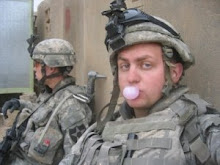
Lauren told me recently, "you're the most sentimental person I know." If you're one of the faithful few that have read my blog in its entirety, you're most likely to agree with her. I'm a sucker for milestones. I wrote about how it felt to be exactly one year away from getting out of the Army, and a fictitious account about coming home the day we were scheduled to, before being extended three months. A week after we returned on September 12, I described what it was like to be back. You can find it three entries below this one, under the Rush Limbaugh hootenanny.
Now it has been a month since I've returned to the states, but this week I've come back to my actual home. At some point in Baqubah I developed a hernia and waited until I made it back to Ft. Lewis to have it properly diagnosed and treated. I went into surgery last week and am recovering just fine. It still hurts to laugh (which is bad news for someone who giggles at their own jokes.) They gave me two weeks for recovery and I decided to take that in my hometown. Far away from a military base, the question arises with ferocious intensity: what does it feel like to be back? My usual short answer is, "it's nice to have a warm bed again." But that's not quite how it is. It almost feels like it gets harder, not easier.
Last week I was invited to a dinner hosted by Lauren's mother. Joining us would be Lauren's sister, her cousin who I had already met, another cousin I hadn't, and her fiancé. I retained my 'quiet with a few clever puns' persona and as such, didn't contribute much to the conversation. It felt like I had nothing of relevance to say about the topics that came up. My grasp of news and politics was more than a year old; only the biggest stories made their way across the ocean. By taking part in the biggest thing happening in our culture, I sacrificed being in the culture itself. I refused to be that guy who starts off every sentence with "this one time in Iraq..." But my options are slim. I could recall stories of my trip to Europe in April, but then it would be, "Dude, this one time in Amsterdam." There's only so many times you can regale people with stories about aggressive transvestite prostitutes.
With my Texan accent sticking out like a Dutch hooker's crotch, it was only a matter of time before Lauren's cousin asked where I was from. I told her I had lived in north Texas most of my life and went back to poking around the sausage in my spaghetti. Lauren's mother then gave an updated biography, saying I had just gotten back from Iraq and that I chronicled my deployment in a blog (wink!). After she asked what I wrote about, I launched into a tirade about applying personal experiences of the war to the larger aspect that isn't in the mainstream media. I must've looked silly, talking with urgency and saying more words in one minute than the whole evening prior. I realized the conundrum I was in. The subject I didn't want to come up was the only one I can apply myself to. An elephant in the room that only I could see.
After a month I'm still not quite comfortable with being in small, crowded and loud places like bars. My senses are more refined now. I'm a more attentive driver and I can see and hear things a lot differently. A club with a thousand different conversations used to be collective noise. Now I hear an endless amount of distinct voices and every note coming from the DJ. I'm agitated by people coming too close or brushing up against me like never before. I don't jump, twitch or moan when I hear an expected loud noise. You know the feeling you get when you narrowly avoid a car crash? That's what I get. I'm perfectly fine at first glance, but the blood drains from my face and my scalp tingles. I may or may not break into a sweat at this point. I don't recall many dreams while I was in Iraq, but now they flood my subconscious. In one I'm riding in a bus and hanging out the window. Another bus in the opposite lane passes by, and Jesse Williams is waving to me from inside. I wave back. Another has me on a routine patrol when I find half a body on the side of the road. It's Chevy. His face is twisted but recognizable. His lower half is gone, despite his body being intact when he died.
Despite the hardships we face alone, I feel incredibly lucky to have my family and friends here for me, who understand the best they can. It was fitting I started this entry with Lauren, wise and empathetic beyond her years. A month with these challenges seems minuscule when compared to the month of joy I shared with her.
For everyone else, the nature of this war prevents the public from a full grasp of understanding. In the wars of past generations, soldiers volunteered or were drafted by the millions. In the case of World War II, families endured rations and donated to the war effort. Almost every single American contributed to victory. In the case of Iraq and Afghanistan, the war is squeezed into a half hour of prime time television. In WWII, in Korea, in Vietnam, we were a country at war. Now we're a military at war, with less than 1% of the population in uniform. Unless you have a friend or family member in the military, it's a separate reality. In airports and in living rooms, you can see for yourself the effect in the eyes of a soldier at war for fifteen months at a time, hidden behind a smile that conceals a secret: you'll never quite understand what we did there.
Like Atlas, we carry the immense burden of the country on our shoulders, waiting for the day seemingly long into the future when the American people say, that will do.
AH
Friday, October 12, 2007


Tuesday, October 02, 2007
Rushing Deeper Into The Hole
Well this Rush Limbaugh controversy certainly stayed around longer than I thought, even getting bigger as time goes on. Vote Vets, the group of anti-Iraq War veterans that help get former soldiers elected into office, put up a new ad that will be airing on CNN and Fox News tomorrow and Thursday:
After watching that, check out the details about the video from Brandon Friedman, vice chairman of Votevets.org.
We learn that the man in the ad was wounded in a suicide bomber attack while convoying in Mosul in 2003 and suffered traumatic brain injury as well as shrapnel to the head. As you can imagine, he has since become a vocal critic of the Iraq war.
Of course Rush got wind of this ad (a radio version will run during his show in some areas!) and had this to say about it:
People have been writing in en masse to tell me how I got the story wrong, and Rush supports the troops and so on. But this is what he has been accused of the whole time: holding veterans in superhero regard if they support the war to appeal to the patriotic senses of his listeners while simultaneously putting down dissenting soldiers, to appeal to the angry, resentful senses of his listeners. In 2005 when anti war veteran Paul Hackett ran for the Ohio Senate, Rush called him a military "staff puke," saying he volunteered for Iraq simply to pad his resumé so he could run as a war veteran. A liberal hiding behind a military uniform! I'm sure if he was a pro-war, pro-Bush candidate, the praises would never stop. This strengthens the latest debate on his phony soldier remark last week. Rush's reactionaries and defenders have been telling me the liberal media (namely Media Matters) has taken his 'phony soldier' quote out of context in a smear campaign designed to make Limbaugh appear to be against any soldier against war policy. The article goes on:
Now where did this reporting come from? Daily Kos? Moveon.org? The New Republic? Why, none other than Fox News, the last refuge of information for the Rush elitists. How's that for bias?
Apparently Rush has no shame left, comparing Brian McGough to a suicide bomber on behalf of liberal jihadists. I am surprised, however, that he acknowledged someone who was phony in the first place. Thanks for your service, but you obviously have no independent thought Brian. You parrot leftist views while Petraeus, representing the political arm of the military, gives no BS assessments without ulterior motives to pad his resumé.
Now you know how Rush stands, here are some letters from his fans:
How does the old saying go:
Believe half of what you see and none of what you hear.
Do your homework or pass on the subject. Simple, eh?
Now go kill an Iranian for me.
--Anonymous
If Rush and people like you put their money where their mouths are, you could kill plenty yourself and we would have no problem with troop levels in Iraq.
You are such a phony. Oh, the things you can do with Photoshop these days. You can even make a sniveling, liberal hippy peaceniks look like soldiers on the front lines. Good try, but your mom accidentally stepped out from behind the garage in one of the shots.
--Anonymous Douche
It's almost like this guy is accusing me of being....false? Bogus? Quick, what's another five letter word for a fake?
Unfortunately you should have listen or read the transcripts instead of believing second hand accounts and rushing to conclusion soldier. He is the biggest supporter of the military and family members and just a little bit of research would have revealed that. Semper Fi
--Anonymous
Unless you're an Iraq war vet running for the Senate! Then Rush calls you names. Again, thanks for your service Paul Hackett! Shitheel!
Read the comments yourself. Some can disagree politely while others are not as good as Rush Limbaugh at hiding contempt for someone who opposes the war.
AH
After watching that, check out the details about the video from Brandon Friedman, vice chairman of Votevets.org.
We learn that the man in the ad was wounded in a suicide bomber attack while convoying in Mosul in 2003 and suffered traumatic brain injury as well as shrapnel to the head. As you can imagine, he has since become a vocal critic of the Iraq war.
Of course Rush got wind of this ad (a radio version will run during his show in some areas!) and had this to say about it:
"This is such a blatant use of a valiant combat veteran, lying to him about what I said and then strapping those lies to his belt, sending him out via the media and a TV ad to walk into as many people as he can walk into. This man will always be a hero to this country with everyone. Whoever pumped him full of these lies about what I said and embarrassed him with this ad has betrayed him, they aren't hurting me they are betraying this soldier."
People have been writing in en masse to tell me how I got the story wrong, and Rush supports the troops and so on. But this is what he has been accused of the whole time: holding veterans in superhero regard if they support the war to appeal to the patriotic senses of his listeners while simultaneously putting down dissenting soldiers, to appeal to the angry, resentful senses of his listeners. In 2005 when anti war veteran Paul Hackett ran for the Ohio Senate, Rush called him a military "staff puke," saying he volunteered for Iraq simply to pad his resumé so he could run as a war veteran. A liberal hiding behind a military uniform! I'm sure if he was a pro-war, pro-Bush candidate, the praises would never stop. This strengthens the latest debate on his phony soldier remark last week. Rush's reactionaries and defenders have been telling me the liberal media (namely Media Matters) has taken his 'phony soldier' quote out of context in a smear campaign designed to make Limbaugh appear to be against any soldier against war policy. The article goes on:
The problem with the exchange, say critics, is that Limbaugh refers to multiple "soldiers." He gets to a conversation about Macbeth about two minutes after referring to "phony soldiers." In subsequent radio shows, Limbaugh attempted to clarify his position, but muddied the waters by editing out a portion of it, prompting outrage from the liberal media watchdog Media Matters, which has been driving this latest controversy.
Now where did this reporting come from? Daily Kos? Moveon.org? The New Republic? Why, none other than Fox News, the last refuge of information for the Rush elitists. How's that for bias?
Apparently Rush has no shame left, comparing Brian McGough to a suicide bomber on behalf of liberal jihadists. I am surprised, however, that he acknowledged someone who was phony in the first place. Thanks for your service, but you obviously have no independent thought Brian. You parrot leftist views while Petraeus, representing the political arm of the military, gives no BS assessments without ulterior motives to pad his resumé.
Now you know how Rush stands, here are some letters from his fans:
How does the old saying go:
Believe half of what you see and none of what you hear.
Do your homework or pass on the subject. Simple, eh?
Now go kill an Iranian for me.
--Anonymous
If Rush and people like you put their money where their mouths are, you could kill plenty yourself and we would have no problem with troop levels in Iraq.
You are such a phony. Oh, the things you can do with Photoshop these days. You can even make a sniveling, liberal hippy peaceniks look like soldiers on the front lines. Good try, but your mom accidentally stepped out from behind the garage in one of the shots.
--Anonymous Douche
It's almost like this guy is accusing me of being....false? Bogus? Quick, what's another five letter word for a fake?
Unfortunately you should have listen or read the transcripts instead of believing second hand accounts and rushing to conclusion soldier. He is the biggest supporter of the military and family members and just a little bit of research would have revealed that. Semper Fi
--Anonymous
Unless you're an Iraq war vet running for the Senate! Then Rush calls you names. Again, thanks for your service Paul Hackett! Shitheel!
Read the comments yourself. Some can disagree politely while others are not as good as Rush Limbaugh at hiding contempt for someone who opposes the war.
AH
Friday, September 28, 2007
The Real Deal
Blue Girl directed me to a very interesting story about Rush Limbaugh, who called veterans opposed to the war phony soldiers. Of course, this is the same Rush Limbaugh who threw a fit about the Moveon.org Petraeus ad, calling it "contemptible" and "indecent." Apparently anyone in the military is above criticism as long as they agree with Rush's brave belief that we should be in Iraq "as long as it takes." And I use the term 'we' loosely, as I believe the closest Rush has ever gotten to combat was watching We Were Soldiers with surround sound.
When I was a kid I watched Rush with my dad every morning when he was still on TV and always found him pretty funny and clever. Over the years I didn't have a very concrete opinion about him, I just knew him as the kooky conservative radio host who defended Bush at every turn (and hey, so did I). What did Rush and I have to lose when the war in Iraq started in 2003? I didn't have any family in the military, and all my friends were too young to even enlist. Why not go kick the shit out of a country, as long as someone else was doing it?
This was the last time Rush and I would agree on the war, so here's my opinion of you, Rush: you're as smart, selfless and courageous as I was as a 17 year old high school senior.
You make a good point that people who joined the military during the war knew they were going and shouldn't be against it. As I've seen since I joined in 2004, everyone in the military is gung ho to a certain extent, at least in the beginning of their career. I was part of a large group of new guys who got to a unit that just got back from a year long deployment. After our hazing sessions became less and less frequent in the following months, we listened to the stories all of them were telling, of vicious firefights and rescue missions. We all wanted to do our part, we all wanted to get some too. We were going to see what it was like to take a life. Too bad Rush missed his chance to do so, or maybe he'd be singing a different tune. In 1992, ABC newsman Jeff Greenfield posed a question to Rush, asking if he had ever served in the military during the Vietnam War. Here is what Rush had to say:
As a phony civilian hoping to be a phony soldier, I tried to enlist in the military after I graduated high school in 2003. In 2002 I had a Nissen fundoplication operation to repair a hiatal hernia caused by severe acid reflux, preventing esophageal cancer later in life. I was immediately flagged on my attempt to enlist because of this surgery, as there was a chance that a physically stressful job such as Army infantry would complicate it. I had to be cleared by the surgeon general before entering the service. As the war kept on, so did I. I waited for a little over a year to get my results back: I would finally be able to join despite the surgery I had two years prior. As Rush found after dropping out of his first year of college at Southeast Missouri State University in 1969-1970, he found himself on draft status. Nothing that a claim of an old football injury or a boil on the ass can take care of, though! The medical deferment he was referring to was a pilonidal cyst, which apparently is a clump of severely ingrown hairs. That barred him from enlistment, and I'm sure he was ecstatic. After all, there was a war on. Here's a first hand account of the surgery that was done to correct it. She claims that in eight weeks, it was perfectly healed. Rush is willing to sacrifice the lives of Americans in Iraq but not his own ass (literally) in a simple surgery. I waited a year to get in, and he didn't try. Boy, do I really give an effort at being a phony soldier!
Speaking of phony soldiers, I wanted to show Rush a few that I know:

This was taken on a rooftop during a firefight on March 24 in Baqubah. One guy lost a leg up to his knee and another lost a foot in an IED blast that day. Talk about sacrifices! Out of seven Americans on that rooftop, one is going to reenlist! The rest decided to get out to avoid going to Iraq again, despite what Mike from Olympia, Washington said on your show about what real soldiers say, like "they want to be over in Iraq. They understand their sacrifice, and they're willing to sacrifice for their country." All I see is a bunch of phonies!

This is Matt tugging on a buried wire connected to a massive IED underneath the road. In Baqubah they were so prevalent that the explosive ordnance disposal dudes couldn't take care of them all in the city, so we started finding them and blowing them up ourselves. Matt just finished his second tour, in which he was deployed a total of 27 months. This coward that followed wires to huge bombs in the road is getting out in a few months. And that's a good thing, as this military could use a lot less phony soldiers.

Here's Bill, digging up a grave containing a woman with her two daughters in a field in Baqubah. They were executed by gunshot and buried in the same hole. We took turns digging as the brave men of the Iraqi Army watched and joked. Bill also served 27 months in combat and like Matt, will be getting out of the Army in a couple months. Good riddance, phony!

I'm not above self-criticism. This is me on the last patrol we did in Old Baqubah on August 20. Like a coward I stayed in Iraq only fifteen months. We heard rumors that the 1920s might ambush us on our last patrol. Too bad they didn't, or they would've sent a lot of phonies home in body bags!

This picture makes me sick to my stomach. I photographed a bunch of cut-and-runners boarding a plane during a pit stop in Ireland on our way back to the states on September 12. Hello, don't they know there's a war going on? These phonies left Iraq before the job was done! Seriously, we need soldiers who want to be in Iraq for as long as it takes.
And finally:

This is Chevy in Baghdad. Brian Chevalier was going to reenlist but decided against it before he was killed on March 14 during our first mission in Baqubah. His phony life was celebrated in a phony memorial where everyone who knew him cried phony tears. A phony American flag draped over his phony coffin when his body came home. It was presented to his phony mother and phony daughter.
I would be in awe if I ever met a real life soldier, and not a phony one like Bill, Matt or Brian Chevalier. Thank you, Rush Limbaugh, for telling me the difference. I hope your ass is ok.
AH
When I was a kid I watched Rush with my dad every morning when he was still on TV and always found him pretty funny and clever. Over the years I didn't have a very concrete opinion about him, I just knew him as the kooky conservative radio host who defended Bush at every turn (and hey, so did I). What did Rush and I have to lose when the war in Iraq started in 2003? I didn't have any family in the military, and all my friends were too young to even enlist. Why not go kick the shit out of a country, as long as someone else was doing it?
This was the last time Rush and I would agree on the war, so here's my opinion of you, Rush: you're as smart, selfless and courageous as I was as a 17 year old high school senior.
You make a good point that people who joined the military during the war knew they were going and shouldn't be against it. As I've seen since I joined in 2004, everyone in the military is gung ho to a certain extent, at least in the beginning of their career. I was part of a large group of new guys who got to a unit that just got back from a year long deployment. After our hazing sessions became less and less frequent in the following months, we listened to the stories all of them were telling, of vicious firefights and rescue missions. We all wanted to do our part, we all wanted to get some too. We were going to see what it was like to take a life. Too bad Rush missed his chance to do so, or maybe he'd be singing a different tune. In 1992, ABC newsman Jeff Greenfield posed a question to Rush, asking if he had ever served in the military during the Vietnam War. Here is what Rush had to say:
I had student deferments in college, and upon taking a physical, was discovered to have a physical- uh, by virtue of what the military says, I didn't even know it existed- a physical deferment and then the lottery system came along, where they chose your lost by birth date, and mine was high. And I did not want to go, just as Governor Clinton didn't.
As a phony civilian hoping to be a phony soldier, I tried to enlist in the military after I graduated high school in 2003. In 2002 I had a Nissen fundoplication operation to repair a hiatal hernia caused by severe acid reflux, preventing esophageal cancer later in life. I was immediately flagged on my attempt to enlist because of this surgery, as there was a chance that a physically stressful job such as Army infantry would complicate it. I had to be cleared by the surgeon general before entering the service. As the war kept on, so did I. I waited for a little over a year to get my results back: I would finally be able to join despite the surgery I had two years prior. As Rush found after dropping out of his first year of college at Southeast Missouri State University in 1969-1970, he found himself on draft status. Nothing that a claim of an old football injury or a boil on the ass can take care of, though! The medical deferment he was referring to was a pilonidal cyst, which apparently is a clump of severely ingrown hairs. That barred him from enlistment, and I'm sure he was ecstatic. After all, there was a war on. Here's a first hand account of the surgery that was done to correct it. She claims that in eight weeks, it was perfectly healed. Rush is willing to sacrifice the lives of Americans in Iraq but not his own ass (literally) in a simple surgery. I waited a year to get in, and he didn't try. Boy, do I really give an effort at being a phony soldier!
Speaking of phony soldiers, I wanted to show Rush a few that I know:
This was taken on a rooftop during a firefight on March 24 in Baqubah. One guy lost a leg up to his knee and another lost a foot in an IED blast that day. Talk about sacrifices! Out of seven Americans on that rooftop, one is going to reenlist! The rest decided to get out to avoid going to Iraq again, despite what Mike from Olympia, Washington said on your show about what real soldiers say, like "they want to be over in Iraq. They understand their sacrifice, and they're willing to sacrifice for their country." All I see is a bunch of phonies!
This is Matt tugging on a buried wire connected to a massive IED underneath the road. In Baqubah they were so prevalent that the explosive ordnance disposal dudes couldn't take care of them all in the city, so we started finding them and blowing them up ourselves. Matt just finished his second tour, in which he was deployed a total of 27 months. This coward that followed wires to huge bombs in the road is getting out in a few months. And that's a good thing, as this military could use a lot less phony soldiers.
Here's Bill, digging up a grave containing a woman with her two daughters in a field in Baqubah. They were executed by gunshot and buried in the same hole. We took turns digging as the brave men of the Iraqi Army watched and joked. Bill also served 27 months in combat and like Matt, will be getting out of the Army in a couple months. Good riddance, phony!
I'm not above self-criticism. This is me on the last patrol we did in Old Baqubah on August 20. Like a coward I stayed in Iraq only fifteen months. We heard rumors that the 1920s might ambush us on our last patrol. Too bad they didn't, or they would've sent a lot of phonies home in body bags!
This picture makes me sick to my stomach. I photographed a bunch of cut-and-runners boarding a plane during a pit stop in Ireland on our way back to the states on September 12. Hello, don't they know there's a war going on? These phonies left Iraq before the job was done! Seriously, we need soldiers who want to be in Iraq for as long as it takes.
And finally:
This is Chevy in Baghdad. Brian Chevalier was going to reenlist but decided against it before he was killed on March 14 during our first mission in Baqubah. His phony life was celebrated in a phony memorial where everyone who knew him cried phony tears. A phony American flag draped over his phony coffin when his body came home. It was presented to his phony mother and phony daughter.
I would be in awe if I ever met a real life soldier, and not a phony one like Bill, Matt or Brian Chevalier. Thank you, Rush Limbaugh, for telling me the difference. I hope your ass is ok.
AH
Wednesday, September 19, 2007
Do Not Adjust Your Television Set
It has been a week since our triumphant return to the states, to America, the first world. And as it wasn't quite like I imagined in June, it was every bit as wonderful and surreal as I thought it would be. Every moment leading up to the march to the gym was met with cheers and hysterical laughter. Getting off the plane, turning in our guns, getting on a bus...at every step we got closer to seeing loved ones. You could feel it in your face and hear it in the voice of anyone you talked to.
We took a bus to the base gym, where our friends and family waited for us. We stopped short to get lined up nice and neat so we could march in with our backpacks and laptop cases around our necks. Near the entrance there were people already holding signs and clapping. Someone yelled, "hey, Horton!" but luckily I wasn't met with a barrage of cabbage and apple cores. A few more steps and we entered the gym. By the crowd's reaction, it's as if we won the Superbowl. We stopped in the center and it was still so loud no one heard the shortest speech of all time given by a general. "Good job etc, proud of you all yadda yadda, be safe and so forth." On that note, it became a mad house as people rushed from the bleachers and into the scattered formation. Foregoing all military discipline, I looked around the room while at attention to locate my family. As the gym started to clear out I found Bryan, also family-less, and we agreed to look together. Suddenly I caught a glimpse of my dad running up, with my mom not far behind and with her, Lauren.
One of the first things I said to my dad after a big hug was, man, that was a long twelve months.
Seeing my mom get teary-eyed almost made me let loose, but I held my composure by making a point to. Lauren told me she wasn't going to be there, as to make it a family event. But she decided to come and we're both glad she did. A beautiful moment with a beautiful woman. Yes, this is what I've been missing.
Now that things have settled down a little (ha!), I keep getting the same question: what does it feel like to be back? Well, imagine a kid tweaking on Ritalin and Mountain Dew IVs and trying to sit still in church.
In Iraq it feels like the rest of the world is another isolated planet. News came in bits and pieces and often by word of mouth. Our only connection to our own culture was from magazines a few months old and bootleg movies taped with a camcorder in some dank Indonesian movie theater. As much as we didn't want it to, the world kept on turning without us. Anniversaries, births, deaths, all kept happening despite our situation.
Back in the states, everything moves fast. Really fast. Traffic never exceeded about 45 miles an hour in combat, but on the highway it feels like your blood is going to boil at seventy. Every minute, tiny thing seems huge and at once, hilarious. Driving down the interstate I saw a piece of trash caught in the grass by the shoulder. Look at that! I said with a giggle. It's stuck!
Though I've related some pretty gruesome stories in earlier editions of this blog, I never provided much insight to how I felt about my own safety and mortality. I didn't want my family and friends to know that aspect while I was still in danger so their fears and anxiety weren't compounded any further. There is said to be three stages of clarity about one's life in a war. I didn't come up with the theory, but I sure have felt it. At the beginning, you feel like you're invincible and if anything bad happens, it's going to happen to some other guy. Then when people start to get hurt and killed, you think to yourself, I better look out or I'll be next. The final stage comes after the second one wears on you after awhile. Your thought is, I'm going to die next unless I make it out of here as soon as possible.
I entered the final stage on March 14, and there it remained until August 25.
There were times when many of us weren't killed due to good ol' fashioned luck, a soldier's best friend. Bullets missing heads by quite literally an inch or less (and even a couple dudes got grazed on the dome). The IED that killed Chevy was blown at the very front of the Stryker. If the guy set it off just a half second later, it would have blown under the troop carrying compartment. I don't believe in miracles, but I saw a lot of them.
From boots to Pumas, to sweat soaked and shit smelling trousers to Guess jeans, we're trying to rejoin society the best we can. But not everyone who left in June of 2006 was able to make that transition. These are the names of the fallen of Task Force 5/20:


So. What does it feel like to be back? It feels great, but it hurts, too.
AH
We took a bus to the base gym, where our friends and family waited for us. We stopped short to get lined up nice and neat so we could march in with our backpacks and laptop cases around our necks. Near the entrance there were people already holding signs and clapping. Someone yelled, "hey, Horton!" but luckily I wasn't met with a barrage of cabbage and apple cores. A few more steps and we entered the gym. By the crowd's reaction, it's as if we won the Superbowl. We stopped in the center and it was still so loud no one heard the shortest speech of all time given by a general. "Good job etc, proud of you all yadda yadda, be safe and so forth." On that note, it became a mad house as people rushed from the bleachers and into the scattered formation. Foregoing all military discipline, I looked around the room while at attention to locate my family. As the gym started to clear out I found Bryan, also family-less, and we agreed to look together. Suddenly I caught a glimpse of my dad running up, with my mom not far behind and with her, Lauren.
One of the first things I said to my dad after a big hug was, man, that was a long twelve months.
Seeing my mom get teary-eyed almost made me let loose, but I held my composure by making a point to. Lauren told me she wasn't going to be there, as to make it a family event. But she decided to come and we're both glad she did. A beautiful moment with a beautiful woman. Yes, this is what I've been missing.
Now that things have settled down a little (ha!), I keep getting the same question: what does it feel like to be back? Well, imagine a kid tweaking on Ritalin and Mountain Dew IVs and trying to sit still in church.
In Iraq it feels like the rest of the world is another isolated planet. News came in bits and pieces and often by word of mouth. Our only connection to our own culture was from magazines a few months old and bootleg movies taped with a camcorder in some dank Indonesian movie theater. As much as we didn't want it to, the world kept on turning without us. Anniversaries, births, deaths, all kept happening despite our situation.
Back in the states, everything moves fast. Really fast. Traffic never exceeded about 45 miles an hour in combat, but on the highway it feels like your blood is going to boil at seventy. Every minute, tiny thing seems huge and at once, hilarious. Driving down the interstate I saw a piece of trash caught in the grass by the shoulder. Look at that! I said with a giggle. It's stuck!
Though I've related some pretty gruesome stories in earlier editions of this blog, I never provided much insight to how I felt about my own safety and mortality. I didn't want my family and friends to know that aspect while I was still in danger so their fears and anxiety weren't compounded any further. There is said to be three stages of clarity about one's life in a war. I didn't come up with the theory, but I sure have felt it. At the beginning, you feel like you're invincible and if anything bad happens, it's going to happen to some other guy. Then when people start to get hurt and killed, you think to yourself, I better look out or I'll be next. The final stage comes after the second one wears on you after awhile. Your thought is, I'm going to die next unless I make it out of here as soon as possible.
I entered the final stage on March 14, and there it remained until August 25.
There were times when many of us weren't killed due to good ol' fashioned luck, a soldier's best friend. Bullets missing heads by quite literally an inch or less (and even a couple dudes got grazed on the dome). The IED that killed Chevy was blown at the very front of the Stryker. If the guy set it off just a half second later, it would have blown under the troop carrying compartment. I don't believe in miracles, but I saw a lot of them.
From boots to Pumas, to sweat soaked and shit smelling trousers to Guess jeans, we're trying to rejoin society the best we can. But not everyone who left in June of 2006 was able to make that transition. These are the names of the fallen of Task Force 5/20:
Cpl. Casey Mellen - Headquarters
Huachua City, AZ
KIA Mosul, September 25, 2006
Cpl. Billy Farris - Headquarters
Bapchule, AZ
KIA Anbar, December 3, 2006
Cpl. Brian Chevalier - Bravo
Athens, GA
KIA Baqubah, March 14, 2007
SSG. Jesse Williams - Bravo
Santa Rosa, CA
KIA Baqubah, April 8, 2007
SSG. Vincenzo Romeo - Alpha
Lodi, NJ
KIA Baqubah, May 6, 2007
Sgt. Jason Harkins - Alpha
Clarkesville, GA
KIA Baqubah, May 6, 2007
Sgt. Joel Lewis - Alpha
Sandia Park, NM
KIA Baqubah, May 6, 2007
Cpl. Matthew Alexander - Alpha
Gretna, NE
KIA Baqubah, May 6, 2007
Cpl. Anthony Bradshaw - Alpha
San Antonio, TX
KIA Baqubah, May 6, 2007
Cpl. Michael Pursel - Alpha
Clinton, UT
KIA Baqubah, May 6, 2007
Sgt. Daniel Nguyen - B 1/12 (Cav)
Sugarland, TX
KIA Baqubah, May 8, 2007
Sgt. Jason Vaughn - Alpha
Iuica, MS
KIA Baqubah, May 9, 2007
Sgt. Anselmo Martinez - B 1/12 (Cav)
Robstown, TX
KIA Baqubah, May 18, 2007
Spc. Joshua Romero - B 1/12 (Cav)
Crowley, TX
KIA Baqubah, May 18, 2007
Spc. Casey Nash - B 1/12 (Cav)
Baltimore, MD
KIA Baqubah, May 18, 2007
Sgt. Iosiwo Uruo - B 1/14
Agana Heights, Guam
KIA Baqubah, May 24, 2007
Spc. Francis Trussel - B 1/12 (Cav)
Lincoln, IL
KIA Baqubah, May 26, 2007
Sgt. Andrew Higgins - Alpha
Hayward, CA
KIA Baqubah, June 5, 2007
PV2 Scott Miller - Headquarters
Casper, WY
KIA Baqubah, June 9, 2007
Cpl. Darryll Linder - A 1/12 (Cav)
Hickory, NC
KIA Baqubah, June 19, 2007
Cpt. Drew Jensen - Headquarters
Clackamas, OR
Died in Seattle on September 7, 2007 from wounds suffered May 7, 2007


So. What does it feel like to be back? It feels great, but it hurts, too.
AH
Wednesday, August 29, 2007
Dude!
I must say, this past week has been quite exciting. On the morning of August 25, half my company convoyed in filthy and battered Strykers from Baqubah to Taji, our final mission of the deployment. Taji was our second home in Iraq and our springboard into Baghdad during the winter months. Now it acts as a staging area to get equipment, vehicles and men home next month.
Every trivial action was exhilarating when you realize it’s the last time you’ll ever do it. Loading a magazine, chambering a round, catching a warm desert breeze in your face going down the road for the final time. The air of finality is intoxicating, and you can feel it in your bones and see it in the face of everyone around you. A great burden was lifted as soon as we pulled into the wire and safety of Taji. We flew from Kuwait to Mosul on July 21, 2006, 72 hours after my twenty-first birthday. We ended operations on August 25, 2007. For exactly 400 days we held onto our humanity the best we could, sometimes forgetting we had it. The day we got to Baqubah and a Stryker had already been destroyed by an IED, I was on a rooftop with a bird’s eye view of everything around. Rockets and tracers were going overhead and buildings were catching fire. I looked at the carnage happening below, with my heart in my throat, and repeated in my head, how are we going to get out of this? How are we going to get out of this? I didn’t even know my friend was dead yet.
But everything that has a beginning has an end. After 400 days, we’re done. Over with! For my French readers, Le Fin. In a few short weeks we’ll return home with happy, yet heavy, hearts. Thanks to the recent L.A. Times article that quoted me and likely brought you here, my readership has grown exponentially. And with it, come the doubters and naysayers who question the accuracy and integrity of my writing (a soldier who doesn’t spew administration talking points? Has the whole world gone bonkers?!). All this attention is new and strange to me, so I googled myself to see what is out there. I came across a message board thread on a military website titled: Army of Dude: Is Alex Horton a real person? Why, yes. Yes I am. I am not a figment of someone’s imagination and I’m not a fiction writer. I wish I was that creative. In light of Beauchamp’s recent adventures, some have sneered that I should write for The New Republic (a shot at my supposedly doubtful credibility). I’m not sure my word means anything on the internet, but if you’re really adamant about busting me, blogosphere, give it a try!
I’m glad to have a bigger forum than a week ago, regardless of the critical fallout. The intention of this blog from day one was to chronicle my experiences in a way for people to understand and interpret what was going on beyond what was being filtered, distilled and spat out of the mainstream media. When the deputy prime minister came to Baqubah for the first time a few weeks ago, an envoy of officers followed. Captains, lieutenant colonels and generals all took part in the tour of the local shops and visits with the residents. We were ordered to stay out of any pictures taken. Why? To falsely show that the Iraqi Army was in charge and we were on the sidelines.
In the last month of the deployment, on one of our few days off, we risked our lives so the Army, at some level, could throw a rose colored lens onto a news camera for the benefit of...I don’t know who.
Later on that day, a two star general got on our truck to be escorted back to the base. The captains and colonels around him talked about how Diyala was really shaping up and that Baqubah would be a shining example of the surge in no time, thanks in part by the 1920s! This was great for me to see and hear, because I finally got it. It took me fifteen months, but my epiphany was complete. Generals see Iraq in a unique way for two reasons. One, they take the word of anyone under them, which will almost always be positive no matter what. I doubt many have the guts to tell a general that things aren’t going exactly as planned. And two, they view Iraq in quick spurts with over-the-top security measures. I took a picture of the mob next to the deputy prime minister’s SUV, and there was an entourage of no less than fifteen American and Iraqi soldiers in a span of ten feet. Needless to say, the two star was well protected. We’ve walked the most dangerous streets on planet earth with less people. Surprise, some of us have a different perspective on the way this country is going.
I’m not a radical or an extremist, as you might think. My biggest fans are in my platoon. The most common thing I hear from them is, this is what I’ve been thinking the whole time. So my thoughts and ruminations aren’t entirely unique. I just simply have the attention of people to tell it to in the country we left behind fifteen months ago.
President Eisenhower warned of the growing military industrial complex in his farewell address. Since Dick Cheney can now afford solid gold oil derricks, it’s safe to say we failed Ike miserably. After losing two friends and over a dozen comrades, I have this to say:
Do not wage war unless it is absolutely, positively the last ditch effort for survival.
I was a struggling senior in high school when the invasion took place, and I supported it. I was mesmerized by the way we raced across the desert and took Baghdad in less than a month. War was a sleek, glossy commercial on TV, and we always won at the end. It’s easy to be for a war when you have absolutely no connection with it. Patriotism lead me to believe what we were doing was right and noble. What a difference a deployment can make.
The public can do something about this. It doesn’t have to be a hopeless cause forever. Write your Congressmen, go to a rally, read as much as you can about Iraq to see it for what it is: a place men go to lose their minds and their lives. And most importantly, love your children. Teach them that war is not honorable, it’s no plaything cast with an indifferent hand. It’s the most terrible thing man ever brought to the world. My generation didn’t learn from Vietnam, but the next one can learn from us. The memories and spirit of Chevy and Jesse compel you, America. Do not forget your fallen sons.
AH
Every trivial action was exhilarating when you realize it’s the last time you’ll ever do it. Loading a magazine, chambering a round, catching a warm desert breeze in your face going down the road for the final time. The air of finality is intoxicating, and you can feel it in your bones and see it in the face of everyone around you. A great burden was lifted as soon as we pulled into the wire and safety of Taji. We flew from Kuwait to Mosul on July 21, 2006, 72 hours after my twenty-first birthday. We ended operations on August 25, 2007. For exactly 400 days we held onto our humanity the best we could, sometimes forgetting we had it. The day we got to Baqubah and a Stryker had already been destroyed by an IED, I was on a rooftop with a bird’s eye view of everything around. Rockets and tracers were going overhead and buildings were catching fire. I looked at the carnage happening below, with my heart in my throat, and repeated in my head, how are we going to get out of this? How are we going to get out of this? I didn’t even know my friend was dead yet.
But everything that has a beginning has an end. After 400 days, we’re done. Over with! For my French readers, Le Fin. In a few short weeks we’ll return home with happy, yet heavy, hearts. Thanks to the recent L.A. Times article that quoted me and likely brought you here, my readership has grown exponentially. And with it, come the doubters and naysayers who question the accuracy and integrity of my writing (a soldier who doesn’t spew administration talking points? Has the whole world gone bonkers?!). All this attention is new and strange to me, so I googled myself to see what is out there. I came across a message board thread on a military website titled: Army of Dude: Is Alex Horton a real person? Why, yes. Yes I am. I am not a figment of someone’s imagination and I’m not a fiction writer. I wish I was that creative. In light of Beauchamp’s recent adventures, some have sneered that I should write for The New Republic (a shot at my supposedly doubtful credibility). I’m not sure my word means anything on the internet, but if you’re really adamant about busting me, blogosphere, give it a try!
I’m glad to have a bigger forum than a week ago, regardless of the critical fallout. The intention of this blog from day one was to chronicle my experiences in a way for people to understand and interpret what was going on beyond what was being filtered, distilled and spat out of the mainstream media. When the deputy prime minister came to Baqubah for the first time a few weeks ago, an envoy of officers followed. Captains, lieutenant colonels and generals all took part in the tour of the local shops and visits with the residents. We were ordered to stay out of any pictures taken. Why? To falsely show that the Iraqi Army was in charge and we were on the sidelines.
In the last month of the deployment, on one of our few days off, we risked our lives so the Army, at some level, could throw a rose colored lens onto a news camera for the benefit of...I don’t know who.
Later on that day, a two star general got on our truck to be escorted back to the base. The captains and colonels around him talked about how Diyala was really shaping up and that Baqubah would be a shining example of the surge in no time, thanks in part by the 1920s! This was great for me to see and hear, because I finally got it. It took me fifteen months, but my epiphany was complete. Generals see Iraq in a unique way for two reasons. One, they take the word of anyone under them, which will almost always be positive no matter what. I doubt many have the guts to tell a general that things aren’t going exactly as planned. And two, they view Iraq in quick spurts with over-the-top security measures. I took a picture of the mob next to the deputy prime minister’s SUV, and there was an entourage of no less than fifteen American and Iraqi soldiers in a span of ten feet. Needless to say, the two star was well protected. We’ve walked the most dangerous streets on planet earth with less people. Surprise, some of us have a different perspective on the way this country is going.
I’m not a radical or an extremist, as you might think. My biggest fans are in my platoon. The most common thing I hear from them is, this is what I’ve been thinking the whole time. So my thoughts and ruminations aren’t entirely unique. I just simply have the attention of people to tell it to in the country we left behind fifteen months ago.
President Eisenhower warned of the growing military industrial complex in his farewell address. Since Dick Cheney can now afford solid gold oil derricks, it’s safe to say we failed Ike miserably. After losing two friends and over a dozen comrades, I have this to say:
Do not wage war unless it is absolutely, positively the last ditch effort for survival.
I was a struggling senior in high school when the invasion took place, and I supported it. I was mesmerized by the way we raced across the desert and took Baghdad in less than a month. War was a sleek, glossy commercial on TV, and we always won at the end. It’s easy to be for a war when you have absolutely no connection with it. Patriotism lead me to believe what we were doing was right and noble. What a difference a deployment can make.
The public can do something about this. It doesn’t have to be a hopeless cause forever. Write your Congressmen, go to a rally, read as much as you can about Iraq to see it for what it is: a place men go to lose their minds and their lives. And most importantly, love your children. Teach them that war is not honorable, it’s no plaything cast with an indifferent hand. It’s the most terrible thing man ever brought to the world. My generation didn’t learn from Vietnam, but the next one can learn from us. The memories and spirit of Chevy and Jesse compel you, America. Do not forget your fallen sons.
AH
Saturday, August 18, 2007
Stupid Shit of The Deployment Awards!
At the end of our fifteen month deployment, it seemed fitting to resurrect the Stupid Shit series started over a year ago under the gray Washington sky. I envisioned a weekly edition but quickly realized a deployment is a constant parade of ridiculous, asinine, over the top moments that are too numerous to keep track of, and much too difficult to explain in full.
These entries come to you in a fury of writing during the few precious days we have inside the wire. Ever since Baghdad we’ve left the comfort and safety of our huge bases to venture out into the city for as little as two or as much as eight days at a time. There is a direct correlation between the amount of operation activity and the amount of stupid shit that gets piled onto us. As the workload increases, so does the shit, eloquently described as stupid here on out.
Most of the candidates for Stupid Shit of The Deployment, then, come from our stay here in Baqubah. Our operation tempo went from back breaking in Baghdad to soul crushing in Diyala Province. Gone were the days of adequate rest for the trucks and ourselves. Often we’d spend five days out in an Iraqi’s house, sleeping on the roof with lice infested mats and pillows, only to come in for a scant few hours for fuel and a shower (if time permitted). For reasons unknown to anyone, we’d arrive as the chow hall was closing and everyone would make a mad dash for the scraps left over. Stupid, indeed.
So without further ado, the nominees for Stupid Shit of The Deployment:
Working with 1920s – A Sunni insurgent group we’ve been battling for months, responsible for the death of my friend and numerous attacks, agreed to fight Al Qaeda alongside us. Since then, they’ve grown into a much more organized, lethal force. They use this organization to steal cars and intimidate and torture the local population, or anyone they accuse of being linked to Al Qaeda. The Gestapo of the 21st century, sanctioned by the United States Army.
The Surge – The beefing up of ground forces in Iraq at the beginning of the year, started by the 82nd Airborne. Unit deployments were moved up several months to maintain a higher level of boots on the ground to quell the Baghdad situation. What most don’t realize is the amount of actual fighting troops in a brigade, something in the area of 2,000 soldiers in a brigade of 5,000 depending on what unit it is. So for every 2,000 fighters, there are 3,000 pencil pushers sucking up resources in every brigade that was surged. A logistical nightmare that, surprise, failed miserably. The increase of troops in Baghdad pushed the insurgents to rural areas (like Diyala), hence our move here in March. The surge was nothing more than a thorn in the side of nomadic fighters having to move thirty five miles while the generals watched Baghdad with stubborn eyes.
Two Companies Clearing Baqubah – Which brings us to the next nominee. Since Baghdad was the showcase of the war and Baqubah was brimming with super IEDs taking our Bradleys and Abrams tanks, it was decided that a unit needed to be sent there to assist the cavalry unit who averaged a death per week. But how many to send? Someone, somehow, somewhere decided that two companies of Strykers would be adequate to take down what Al Qaeda had deemed their headquarters in Iraq. What came about this oversight? Two hours into the first mission, my friend was killed in a massive IED blast that busted the hell out of the squad leader’s face, resulting in traumatic brain injury and facial reconstruction surgery. The vehicle commander tore his ACL from the concussion. Shrapnel being thrown around the inside of the truck caught one dude in the knee as a dude in the back hatch got rattled around, bruising his back as the other in the hatch was thrown completely out the vehicle. He’s been quiet since then, and was sent home soon after. Returning fire from us and the Bradleys killed an untold number of kids unlucky enough to be in the school next to our position. A wrecker sent out to pick up the destroyed Stryker was the next victim of an IED explosion, killing two men inside. Two more wreckers were sent out, one for the Stryker, one for the now totaled wrecker. As we pulled out that evening, local Iraqis, men, women and children, danced in celebration by the massive crater where the Stryker had been. At once we realized reinforcements were needed but we didn’t get any for two more months. Many more men were killed because we were stretched to our operational breaking point. But there was always more to do. Whoever made the decision to send less than an infantry battalion should be in jail right now.
The Extension – This wasn’t too much of a surprise to us, as we knew in the back of our minds that an extension was in our future. What was surprising was the fact that everyone in Iraq was extended to fifteen month deployments. It was meant to give every unit at least a year in between deployments, as some were coming back to Iraq after only ten months back in the states. Now at the end, it’s not hard to assess the achievements of our three extra months. It seems at a quick glance that we pacified the city, street by street. There was a lull in American deaths because, simply, we absorbed all the bomb blasts or found the IEDs before they could detonate on us. As deadly as they are, deep buried IEDs must take a lot of time to build and emplace. The ones used against us were meant for the cavalry unit, who didn’t have the manpower to patrol the streets like we have been. After we arrived, there were few bombs that haven’t been sitting in the ground for several months already. The enemy ran out of ways to kill us until the ingenious idea of putting bombs in houses took hold. Instead of blowing us up in armored vehicles, they thought about doing it inside an abandoned house. What kills you isn’t the bomb, but the foundation of the house that comes crashing down after the explosion. Wires and triggers are hidden behind doors or underneath rugs, so when we go out and clear blocks and blocks of houses, there’s a pressure plate waiting for you at the foot of the stairs. Only your eyes can save you at this point. That tactic has been born from our proclivity to redundantly clear neighborhoods, and the extension is guilty of claiming lives of men who are running on too little sleep, walking into house after house in the desert heat. When you’re worried about how much water you have left and the trucks are too far away to get more, you tend to miss the trip wire in the dark stairwell. Twelve month deployments are a burden on your body and mind. Asking men for three more months is not only unfair but deadly.
Seven Men Killed At The Same Time – Finally, one of the lowest, saddest points of the deployment came in May. One night, a helicopter spotted several men gathered in the road with a large object. Permission was asked to fire a Hellfire missile at them, as they were obvious IED emplacers. Permission was emphatically denied, but someone decided that a Stryker platoon should head out there anyway to check it out. In tow was a Russian reporter. On a road called Trash Alley, they hit a massive deep buried IED. Everyone in the truck except the driver, six Americans and one Russian, dead. And they didn’t need to be there at all. A helicopter could have killed the insurgents with breathtaking ease. Instead, those guys and the one with the detonator got away in the night. Justice was never done.
And now the moment you've been waiting for. The (dubious) winner of Stupid Shit of The Deployment is:
Two Companies Clearing Baqubah!
While each nominee was unique and shameful in its own way, this outshined them all in how much death and maiming occurred after the fact. Sure, the surge was the cataclysmic event that brought about everything, but the decision to go into the Al Qaeda mother ship with less than a battalion of men was one of the most reckless, foolhardy missteps of the Long War and should go down in the history books as such. In a few weeks we’ll be coming back to the states without our brothers because someone saw a chance for glory and decided to take it. I hope the full birds and the stars were worth our blood.
What has been bothering me this whole deployment is the brevity and formality in which the media handles the death of soldiers. It always goes, “PFC John Smith, Norman, Oklahoma, killed by enemy small arms fire in Baghdad. Assigned to 1/43 Engineers, Third Infantry Division.” What a crock to read that in a paper. It would be wholly appropriate to dedicate a full color photo and a real biography in every paper in America. The anonymity of dead soldiers would evaporate and the public would be forced to look at the faces of the fallen. Would it set in progress change? Perhaps. It certainly would go to show that we’re out here every day, dying for an ideal long forgotten. As for me, I started to sign these entries with my initials long ago to avoid detection by superiors. I could and still can get in trouble for what I’ve written. Lately this blog has been passed around to dudes of every rank, and those who would be punishing me have become readers. So it’s no longer necessary to be sneaky and secretive, another anonymous soldier. My name is Alex Horton, and I’m a 22 year old from Frisco, Texas. I can recite Pulp Fiction line by line and my favorite color is blue. I want to be a journalist when I grow up, and I want to see every part of the world. For the first time in my life I’m an avid reader. Fifteen months here has been fifteen months away from Lauren, the girl I’m crazy about. This wouldn’t be much of a blog without her, as she’s the inspiration for anything creative coming out of me, my beautiful muse.
In the future, I want my children to grow up with the belief that what I did here was wrong, in a society that doesn’t deem that idea unpatriotic.
Herbert Hoover said, "Older men declare war. But it is the youth who must fight and die." These are the young men we can’t afford to go without. Brian Chevalier and Jesse Williams, George Bush and Secretary Gates, we’re all flesh and blood. Every life is sacred. You probably don’t know the names of the first two. But you should.
AH
These entries come to you in a fury of writing during the few precious days we have inside the wire. Ever since Baghdad we’ve left the comfort and safety of our huge bases to venture out into the city for as little as two or as much as eight days at a time. There is a direct correlation between the amount of operation activity and the amount of stupid shit that gets piled onto us. As the workload increases, so does the shit, eloquently described as stupid here on out.
Most of the candidates for Stupid Shit of The Deployment, then, come from our stay here in Baqubah. Our operation tempo went from back breaking in Baghdad to soul crushing in Diyala Province. Gone were the days of adequate rest for the trucks and ourselves. Often we’d spend five days out in an Iraqi’s house, sleeping on the roof with lice infested mats and pillows, only to come in for a scant few hours for fuel and a shower (if time permitted). For reasons unknown to anyone, we’d arrive as the chow hall was closing and everyone would make a mad dash for the scraps left over. Stupid, indeed.
So without further ado, the nominees for Stupid Shit of The Deployment:
Working with 1920s – A Sunni insurgent group we’ve been battling for months, responsible for the death of my friend and numerous attacks, agreed to fight Al Qaeda alongside us. Since then, they’ve grown into a much more organized, lethal force. They use this organization to steal cars and intimidate and torture the local population, or anyone they accuse of being linked to Al Qaeda. The Gestapo of the 21st century, sanctioned by the United States Army.
The Surge – The beefing up of ground forces in Iraq at the beginning of the year, started by the 82nd Airborne. Unit deployments were moved up several months to maintain a higher level of boots on the ground to quell the Baghdad situation. What most don’t realize is the amount of actual fighting troops in a brigade, something in the area of 2,000 soldiers in a brigade of 5,000 depending on what unit it is. So for every 2,000 fighters, there are 3,000 pencil pushers sucking up resources in every brigade that was surged. A logistical nightmare that, surprise, failed miserably. The increase of troops in Baghdad pushed the insurgents to rural areas (like Diyala), hence our move here in March. The surge was nothing more than a thorn in the side of nomadic fighters having to move thirty five miles while the generals watched Baghdad with stubborn eyes.
Two Companies Clearing Baqubah – Which brings us to the next nominee. Since Baghdad was the showcase of the war and Baqubah was brimming with super IEDs taking our Bradleys and Abrams tanks, it was decided that a unit needed to be sent there to assist the cavalry unit who averaged a death per week. But how many to send? Someone, somehow, somewhere decided that two companies of Strykers would be adequate to take down what Al Qaeda had deemed their headquarters in Iraq. What came about this oversight? Two hours into the first mission, my friend was killed in a massive IED blast that busted the hell out of the squad leader’s face, resulting in traumatic brain injury and facial reconstruction surgery. The vehicle commander tore his ACL from the concussion. Shrapnel being thrown around the inside of the truck caught one dude in the knee as a dude in the back hatch got rattled around, bruising his back as the other in the hatch was thrown completely out the vehicle. He’s been quiet since then, and was sent home soon after. Returning fire from us and the Bradleys killed an untold number of kids unlucky enough to be in the school next to our position. A wrecker sent out to pick up the destroyed Stryker was the next victim of an IED explosion, killing two men inside. Two more wreckers were sent out, one for the Stryker, one for the now totaled wrecker. As we pulled out that evening, local Iraqis, men, women and children, danced in celebration by the massive crater where the Stryker had been. At once we realized reinforcements were needed but we didn’t get any for two more months. Many more men were killed because we were stretched to our operational breaking point. But there was always more to do. Whoever made the decision to send less than an infantry battalion should be in jail right now.
The Extension – This wasn’t too much of a surprise to us, as we knew in the back of our minds that an extension was in our future. What was surprising was the fact that everyone in Iraq was extended to fifteen month deployments. It was meant to give every unit at least a year in between deployments, as some were coming back to Iraq after only ten months back in the states. Now at the end, it’s not hard to assess the achievements of our three extra months. It seems at a quick glance that we pacified the city, street by street. There was a lull in American deaths because, simply, we absorbed all the bomb blasts or found the IEDs before they could detonate on us. As deadly as they are, deep buried IEDs must take a lot of time to build and emplace. The ones used against us were meant for the cavalry unit, who didn’t have the manpower to patrol the streets like we have been. After we arrived, there were few bombs that haven’t been sitting in the ground for several months already. The enemy ran out of ways to kill us until the ingenious idea of putting bombs in houses took hold. Instead of blowing us up in armored vehicles, they thought about doing it inside an abandoned house. What kills you isn’t the bomb, but the foundation of the house that comes crashing down after the explosion. Wires and triggers are hidden behind doors or underneath rugs, so when we go out and clear blocks and blocks of houses, there’s a pressure plate waiting for you at the foot of the stairs. Only your eyes can save you at this point. That tactic has been born from our proclivity to redundantly clear neighborhoods, and the extension is guilty of claiming lives of men who are running on too little sleep, walking into house after house in the desert heat. When you’re worried about how much water you have left and the trucks are too far away to get more, you tend to miss the trip wire in the dark stairwell. Twelve month deployments are a burden on your body and mind. Asking men for three more months is not only unfair but deadly.
Seven Men Killed At The Same Time – Finally, one of the lowest, saddest points of the deployment came in May. One night, a helicopter spotted several men gathered in the road with a large object. Permission was asked to fire a Hellfire missile at them, as they were obvious IED emplacers. Permission was emphatically denied, but someone decided that a Stryker platoon should head out there anyway to check it out. In tow was a Russian reporter. On a road called Trash Alley, they hit a massive deep buried IED. Everyone in the truck except the driver, six Americans and one Russian, dead. And they didn’t need to be there at all. A helicopter could have killed the insurgents with breathtaking ease. Instead, those guys and the one with the detonator got away in the night. Justice was never done.
And now the moment you've been waiting for. The (dubious) winner of Stupid Shit of The Deployment is:
Two Companies Clearing Baqubah!
While each nominee was unique and shameful in its own way, this outshined them all in how much death and maiming occurred after the fact. Sure, the surge was the cataclysmic event that brought about everything, but the decision to go into the Al Qaeda mother ship with less than a battalion of men was one of the most reckless, foolhardy missteps of the Long War and should go down in the history books as such. In a few weeks we’ll be coming back to the states without our brothers because someone saw a chance for glory and decided to take it. I hope the full birds and the stars were worth our blood.
What has been bothering me this whole deployment is the brevity and formality in which the media handles the death of soldiers. It always goes, “PFC John Smith, Norman, Oklahoma, killed by enemy small arms fire in Baghdad. Assigned to 1/43 Engineers, Third Infantry Division.” What a crock to read that in a paper. It would be wholly appropriate to dedicate a full color photo and a real biography in every paper in America. The anonymity of dead soldiers would evaporate and the public would be forced to look at the faces of the fallen. Would it set in progress change? Perhaps. It certainly would go to show that we’re out here every day, dying for an ideal long forgotten. As for me, I started to sign these entries with my initials long ago to avoid detection by superiors. I could and still can get in trouble for what I’ve written. Lately this blog has been passed around to dudes of every rank, and those who would be punishing me have become readers. So it’s no longer necessary to be sneaky and secretive, another anonymous soldier. My name is Alex Horton, and I’m a 22 year old from Frisco, Texas. I can recite Pulp Fiction line by line and my favorite color is blue. I want to be a journalist when I grow up, and I want to see every part of the world. For the first time in my life I’m an avid reader. Fifteen months here has been fifteen months away from Lauren, the girl I’m crazy about. This wouldn’t be much of a blog without her, as she’s the inspiration for anything creative coming out of me, my beautiful muse.
In the future, I want my children to grow up with the belief that what I did here was wrong, in a society that doesn’t deem that idea unpatriotic.
Herbert Hoover said, "Older men declare war. But it is the youth who must fight and die." These are the young men we can’t afford to go without. Brian Chevalier and Jesse Williams, George Bush and Secretary Gates, we’re all flesh and blood. Every life is sacred. You probably don’t know the names of the first two. But you should.
AH
Tuesday, August 07, 2007
I Can Taste It
Going home is a beautiful, terrifying thought to have once it gets this close to happening. Not only am I in the twilight of the deployment, but of my military career that began three years ago yesterday. It was then when a nineteen year old chubby kid found himself bound for Ft. Benning, Georgia, fresh and malleable as molten copper. Weeks from completing a fifteen month tour, I’m as confused and apprehensive as that teenager with the twiddling thumbs and darting eyes that had no idea where he was going, or why.
You may want to sit down for this.
This occupation, this money pit, this smorgasbord of superfluous aggression is getting more hopeless and dismal by the second. It’s maddening to think that more than a year’s worth of blood, sweat and tears will lead to little more than a pat on the back and a hideously redundant speech from someone who did none of the bleeding, sweating or crying.
Despite being in a meaningless situation, my life has never had this much meaning. I watch the backs of my friends and they do the same for me. I’ve killed to protect them, and they’ve killed to protect me. For friends and family, being deployed is like being pregnant or surviving a car wreck; everyone is nice to you all of a sudden. People I don’t even know send me kind words and packages from all over. They came out of the woodwork knowing my plight and shared with me heartfelt hope and luck. The fact that you’re reading this now, dear reader, is a testament to that. Would you have cared about what I thought, felt or did two years ago? This position I’m in, shared by less than one percent of the U.S. population, has given me the distinct privilege of sharing my experiences and ruminations of this war, observations undiluted by perpetually delirious officials like General Petreaus and mainstream media sirens. I have felt every extreme of the human condition, physically, morally and emotionally. I’ve never laughed so hard, cried so long or felt more ashamed of myself in all of my life. In a matter of weeks it’ll be over, and I’ll have just the memories of enduring 130 degree heat, and poker games lasting well into the night. I’ll look back on the hysterical laughter during fifteen hour Baghdad clears, the terror of being pinned down by machine gun fire, the sight of a Stryker on its side and the unfolding of a body bag under the flames of a nearby school, unzipped tenderly to fit the body of Chevy as RPGs screamed overhead. Soon this place will all be in the past.
What a beautiful, terrifying thought.
Next month we’ll be the first unit home that completed a three month extension. We were one of few to see Iraq before and after the surge. If the media got anything right, it was that the surge failed. The idea, as birthed in a bloody, mucous-y blob of counter production by General Petreaus, is quite simple on paper, impossible to execute in a meddling reality. The concept is that combat troops would move from their huge bases that housed obscene luxuries like beds, flushing toilets and running water, and into outposts within the most dangerous parts of the city. The key to it all would be 24/7 interaction with Iraqi Army and a constant presence among the Iraqi citizens, giving them confidence in the mission of coalition forces. The building we picked used to be a whiskey distillery, and we’ve been busy putting up concrete barriers and wire around it. A house was too close to where the wall was supposed to be, so engineers blew it to smithereens and sent the family packing. The father owned the plot for forty years and comes by every so often to collect the useful bricks left scattered a hundred yards in every direction. Before he entered once, I patted his seventy year old frame down like a common criminal.
Talk about community interaction!
Our mission now revolves around the outpost. Engineers and Iraqi workers toil day and night to build it up to an acceptable level so we can hand it off to the unit replacing us. We conduct patrols, raids and selective clears of buildings identified by insurgents (1920s) that potentially hide other insurgents (Al Qaeda) while future insurgents (Iraqi Army) sleep all day and eat our food.
So close, yet so far. Deployments start to get dangerous and deadly around month nine, when people start to let their guard down and get sloppy. There’s nothing you can do to stop it. We were ahead of the curve since soldiers in my unit didn’t start dying with regularity until month ten. Now in month fourteen, eight have died in the past week.
General Petreaus must be given accolades for his selflessness. A weaker man would have trembled at the arduous sight of forms authorizing a surge and extension. Thanks to his steadfast character, I’m still here while eight men are not, working toward the noble goal of the surge: building an outpost in podunk Baqubah so the Iraqi Army has a place to sleep, sleep, sleep as the country goes to hell.
Thank your lucky stars we have produced such fine leaders that are brave enough to send us to man these outposts day in and day out.
The most interesting reports in the world must come from the Army Center for Lessons Learned, a government think tank dedicated to updating doctrine based on what soldiers experienced in war. They came out with shocking developments like putting doors on Humvees and having every soldier wear body armor. The most fundamental suggestion they issue, one we’ve heard countless times, is that we shouldn’t set patterns. It boils down to simple things like changing patrol times and reorganizing the order of vehicles in a convoy. But for these outpost operations, that gutless, nonsensical suggestion goes flying out the window. We take the same roads in, at the same time, with the same vehicles going to the same place. It doesn’t take a genius jihadist to see a pattern after a couple of days.
And that’s how we’ve been leading our lives for the past year and two months. Going from place to place and hoping we don’t die on the way there or the way back. With our GPS tracking satellites and laser guided warheads and scientifically developed helmets for ultra comfort, we’re getting beat to the punch every day by a dude crouching behind a wall with a battery and a spool of wire. We’ve been killing the innocent with the guilty because we don’t have the luxury to tell the difference when that bomb goes off and you don’t know which of your friends are dead or alive. In essence, we’ve come here to help each other survive. It worked in most cases and sadly, not in others. We’ve still got a few weeks left until we cross the border of Kuwait, until someone else comes and tells us our job here is done.
I have a chapter that I’d like to add to the next report from the Army Center for Lessons Learned, something that will hopefully be useful in the future of our country:
Chapter 1: Occupation
If you don’t have to, don’t.
AH
You may want to sit down for this.
This occupation, this money pit, this smorgasbord of superfluous aggression is getting more hopeless and dismal by the second. It’s maddening to think that more than a year’s worth of blood, sweat and tears will lead to little more than a pat on the back and a hideously redundant speech from someone who did none of the bleeding, sweating or crying.
Despite being in a meaningless situation, my life has never had this much meaning. I watch the backs of my friends and they do the same for me. I’ve killed to protect them, and they’ve killed to protect me. For friends and family, being deployed is like being pregnant or surviving a car wreck; everyone is nice to you all of a sudden. People I don’t even know send me kind words and packages from all over. They came out of the woodwork knowing my plight and shared with me heartfelt hope and luck. The fact that you’re reading this now, dear reader, is a testament to that. Would you have cared about what I thought, felt or did two years ago? This position I’m in, shared by less than one percent of the U.S. population, has given me the distinct privilege of sharing my experiences and ruminations of this war, observations undiluted by perpetually delirious officials like General Petreaus and mainstream media sirens. I have felt every extreme of the human condition, physically, morally and emotionally. I’ve never laughed so hard, cried so long or felt more ashamed of myself in all of my life. In a matter of weeks it’ll be over, and I’ll have just the memories of enduring 130 degree heat, and poker games lasting well into the night. I’ll look back on the hysterical laughter during fifteen hour Baghdad clears, the terror of being pinned down by machine gun fire, the sight of a Stryker on its side and the unfolding of a body bag under the flames of a nearby school, unzipped tenderly to fit the body of Chevy as RPGs screamed overhead. Soon this place will all be in the past.
What a beautiful, terrifying thought.
Next month we’ll be the first unit home that completed a three month extension. We were one of few to see Iraq before and after the surge. If the media got anything right, it was that the surge failed. The idea, as birthed in a bloody, mucous-y blob of counter production by General Petreaus, is quite simple on paper, impossible to execute in a meddling reality. The concept is that combat troops would move from their huge bases that housed obscene luxuries like beds, flushing toilets and running water, and into outposts within the most dangerous parts of the city. The key to it all would be 24/7 interaction with Iraqi Army and a constant presence among the Iraqi citizens, giving them confidence in the mission of coalition forces. The building we picked used to be a whiskey distillery, and we’ve been busy putting up concrete barriers and wire around it. A house was too close to where the wall was supposed to be, so engineers blew it to smithereens and sent the family packing. The father owned the plot for forty years and comes by every so often to collect the useful bricks left scattered a hundred yards in every direction. Before he entered once, I patted his seventy year old frame down like a common criminal.
Talk about community interaction!
Our mission now revolves around the outpost. Engineers and Iraqi workers toil day and night to build it up to an acceptable level so we can hand it off to the unit replacing us. We conduct patrols, raids and selective clears of buildings identified by insurgents (1920s) that potentially hide other insurgents (Al Qaeda) while future insurgents (Iraqi Army) sleep all day and eat our food.
So close, yet so far. Deployments start to get dangerous and deadly around month nine, when people start to let their guard down and get sloppy. There’s nothing you can do to stop it. We were ahead of the curve since soldiers in my unit didn’t start dying with regularity until month ten. Now in month fourteen, eight have died in the past week.
General Petreaus must be given accolades for his selflessness. A weaker man would have trembled at the arduous sight of forms authorizing a surge and extension. Thanks to his steadfast character, I’m still here while eight men are not, working toward the noble goal of the surge: building an outpost in podunk Baqubah so the Iraqi Army has a place to sleep, sleep, sleep as the country goes to hell.
Thank your lucky stars we have produced such fine leaders that are brave enough to send us to man these outposts day in and day out.
The most interesting reports in the world must come from the Army Center for Lessons Learned, a government think tank dedicated to updating doctrine based on what soldiers experienced in war. They came out with shocking developments like putting doors on Humvees and having every soldier wear body armor. The most fundamental suggestion they issue, one we’ve heard countless times, is that we shouldn’t set patterns. It boils down to simple things like changing patrol times and reorganizing the order of vehicles in a convoy. But for these outpost operations, that gutless, nonsensical suggestion goes flying out the window. We take the same roads in, at the same time, with the same vehicles going to the same place. It doesn’t take a genius jihadist to see a pattern after a couple of days.
And that’s how we’ve been leading our lives for the past year and two months. Going from place to place and hoping we don’t die on the way there or the way back. With our GPS tracking satellites and laser guided warheads and scientifically developed helmets for ultra comfort, we’re getting beat to the punch every day by a dude crouching behind a wall with a battery and a spool of wire. We’ve been killing the innocent with the guilty because we don’t have the luxury to tell the difference when that bomb goes off and you don’t know which of your friends are dead or alive. In essence, we’ve come here to help each other survive. It worked in most cases and sadly, not in others. We’ve still got a few weeks left until we cross the border of Kuwait, until someone else comes and tells us our job here is done.
I have a chapter that I’d like to add to the next report from the Army Center for Lessons Learned, something that will hopefully be useful in the future of our country:
Chapter 1: Occupation
If you don’t have to, don’t.
AH
Tuesday, July 24, 2007
The Enemy of My Enemy of My Enemy of My Enemy...
Fourteen months into this deployment and things are taking a turn for the surreal.
Throughout Mosul and Baghdad, we were fighting what could best described as an insurgent cocktail: parts of Islamic State of Iraq, Al Sadr’s Mahdi Army, 1920 Revolution Brigade and simple, pissed off farmers. Shia and Sunni. Organized militias and rag tags. All they had in common was a shared goal: a total withdraw of occupational forces.
Then it got a little complicated when we moved to Diyala Province, where the 1920 Revolution Brigade was already fighting Al Qaeda for the Diyala capital of Baqubah. To us, to 1920, and to Al Qaeda, Baqubah became the most important city in year four of the Long War. It housed the Al Qaeda network headquarters and was picked for a free-for-all Sunni insurgent cage match, a fight to the death to determine who would emerge victorious to battle the Americans and Iraqi Army in the future.
The 1920 Revolution Brigade (translated from "Brigades of the Revolution of the Twenty") takes its name from the 1920 crusade against British colonial rule. History, it seems, does have a way of repeating itself. The group picked the name to invoke nationalism in local Iraqis fed up with the Americans occupying. A good portion of them were members of Saddam’s regime at one point. Since they’re all Iraqi, they haven’t taken kindly to Al Qaeda, made up of mainly foreign fighters that terrorize neighborhoods and kill indiscriminately. They were natural enemies of 1920, who just wanted those pesky Americans to leave. Fighting with Al Qaeda took its toll. Before CNN broke the story, we had been cooperating for quite some time with members of the 1920 Brigade to flush out Al Qaeda members operating in Baqubah.
They came to us with a truce!
At the beginning of the year they claimed a series of downed helicopters, including the Blackwater Security chopper we responded to. They killed all four of the contractors point blank, one of them execution style and attempted to smuggle the bodies out before we got there. They responded by shooting at us with anti-aircraft guns from a high rise building. After talking with them, we found out they were present during the attack that killed my friend Chevy on March 14.
What must have been an awkward meeting turned into an agreement between coalition forces and 1920: they would stop attacking us if we helped them root out Al Qaeda. They would send one dude on patrol with us, and he’d point out Al Qaeda members and safe houses. They were restricted from carrying weapons during the day and would patrol at night. Things got off to a rough start. Now and again a helicopter would see a car full of gunmen and destroy it. They turned out to be 1920 members on more than one occasion. After we killed a dude with an AK, we always wondered if he was an unlucky Al Qaeda member or a really unlucky 1920 member. Most of us simply considered them a lesser enemy and didn’t care much when we killed our dubious friends by mistake. A common suggestion when we got a source was to “dispose” of him after he outlived his usefulness.
When word got out to the press that we were in cahoots with insurgents, it was spun out of control. General Mixon said something along the lines of “we can’t be sure they all have killed Americans.” Like there is an acceptable percentage of those who have blown an American soldier to pieces. I’m not sure of the opinion of the public at large for reasons that are obvious, but it seems to border on unacceptable. It says a lot about the progress of this war when we’re siding with one insurgent group to battle another. If Jack Bauer doesn’t negotiate with terrorists, why does the American army?
Lately, after leading us to an endless amount of empty Al Qaeda safe houses and supposed cache sites, the 1920 Brigade has gotten more perks since we started this nefarious relationship. They have started to patrol neighborhoods during the day, armed, contrary to the rules established. They take over a building and hold it as a base of operations, setting up concertina wire and giving us their location for our GPS systems so we don’t send a missile into the living room. And of course, we supply them with food and water. We have given them uniforms (yellow reflective belts) and a new name: Baqubah Guardians (or The Bee Gees). At least someone up there has a sense of humor.
After a few months of working with them, I’m still on the fence about the morality of the situation. On one hand, they have fought and killed us and hope to in the future when Al Qaeda is gone. On the other, they are more reliable then the squabbling, sloppy, lazy, sectarian and thieving Iraqi police and army. Our last hope of getting out of this country by the end of the decade is an efficient and professional military and police force. Renewed efforts of military transition teams to prop up credible army and police units have largely failed. We have to watch with suspicious eyes to prevent civilian abuse, looting and vaguely homosexual assault on detainees. We don’t even try to obstruct their cocaine use, which was apparent in Mosul when I saw piles of white powder on the desks at the police department. I declined an offer to sniff a line.
The only thing more impressive than the Shiite IA’s ability to beat the hell out of Sunni civilians is their inability to do anything on their own accord. They simply cannot conduct patrols without us, but 1920 reigns freely in the neighborhoods they operate in. In a few months they are confident in their ability to combat Al Qaeda with minimal help from us, and the IA refuses to do a thirty minute patrol alone. And we still refuse to take off the training wheels.
For now, our relationship with 1920 is one of mutual distrust and hatred, a sign of the times. A conversation between a member of my platoon and a 1920 source was rife with foreboding on the future of this partnership, and of the war to come.
“Do you want to kill me?” asked the soldier.
“Yes,” replied the source, coldly and without emotion. “But not today.”
AH
Throughout Mosul and Baghdad, we were fighting what could best described as an insurgent cocktail: parts of Islamic State of Iraq, Al Sadr’s Mahdi Army, 1920 Revolution Brigade and simple, pissed off farmers. Shia and Sunni. Organized militias and rag tags. All they had in common was a shared goal: a total withdraw of occupational forces.
Then it got a little complicated when we moved to Diyala Province, where the 1920 Revolution Brigade was already fighting Al Qaeda for the Diyala capital of Baqubah. To us, to 1920, and to Al Qaeda, Baqubah became the most important city in year four of the Long War. It housed the Al Qaeda network headquarters and was picked for a free-for-all Sunni insurgent cage match, a fight to the death to determine who would emerge victorious to battle the Americans and Iraqi Army in the future.
The 1920 Revolution Brigade (translated from "Brigades of the Revolution of the Twenty") takes its name from the 1920 crusade against British colonial rule. History, it seems, does have a way of repeating itself. The group picked the name to invoke nationalism in local Iraqis fed up with the Americans occupying. A good portion of them were members of Saddam’s regime at one point. Since they’re all Iraqi, they haven’t taken kindly to Al Qaeda, made up of mainly foreign fighters that terrorize neighborhoods and kill indiscriminately. They were natural enemies of 1920, who just wanted those pesky Americans to leave. Fighting with Al Qaeda took its toll. Before CNN broke the story, we had been cooperating for quite some time with members of the 1920 Brigade to flush out Al Qaeda members operating in Baqubah.
They came to us with a truce!
At the beginning of the year they claimed a series of downed helicopters, including the Blackwater Security chopper we responded to. They killed all four of the contractors point blank, one of them execution style and attempted to smuggle the bodies out before we got there. They responded by shooting at us with anti-aircraft guns from a high rise building. After talking with them, we found out they were present during the attack that killed my friend Chevy on March 14.
What must have been an awkward meeting turned into an agreement between coalition forces and 1920: they would stop attacking us if we helped them root out Al Qaeda. They would send one dude on patrol with us, and he’d point out Al Qaeda members and safe houses. They were restricted from carrying weapons during the day and would patrol at night. Things got off to a rough start. Now and again a helicopter would see a car full of gunmen and destroy it. They turned out to be 1920 members on more than one occasion. After we killed a dude with an AK, we always wondered if he was an unlucky Al Qaeda member or a really unlucky 1920 member. Most of us simply considered them a lesser enemy and didn’t care much when we killed our dubious friends by mistake. A common suggestion when we got a source was to “dispose” of him after he outlived his usefulness.
When word got out to the press that we were in cahoots with insurgents, it was spun out of control. General Mixon said something along the lines of “we can’t be sure they all have killed Americans.” Like there is an acceptable percentage of those who have blown an American soldier to pieces. I’m not sure of the opinion of the public at large for reasons that are obvious, but it seems to border on unacceptable. It says a lot about the progress of this war when we’re siding with one insurgent group to battle another. If Jack Bauer doesn’t negotiate with terrorists, why does the American army?
Lately, after leading us to an endless amount of empty Al Qaeda safe houses and supposed cache sites, the 1920 Brigade has gotten more perks since we started this nefarious relationship. They have started to patrol neighborhoods during the day, armed, contrary to the rules established. They take over a building and hold it as a base of operations, setting up concertina wire and giving us their location for our GPS systems so we don’t send a missile into the living room. And of course, we supply them with food and water. We have given them uniforms (yellow reflective belts) and a new name: Baqubah Guardians (or The Bee Gees). At least someone up there has a sense of humor.
After a few months of working with them, I’m still on the fence about the morality of the situation. On one hand, they have fought and killed us and hope to in the future when Al Qaeda is gone. On the other, they are more reliable then the squabbling, sloppy, lazy, sectarian and thieving Iraqi police and army. Our last hope of getting out of this country by the end of the decade is an efficient and professional military and police force. Renewed efforts of military transition teams to prop up credible army and police units have largely failed. We have to watch with suspicious eyes to prevent civilian abuse, looting and vaguely homosexual assault on detainees. We don’t even try to obstruct their cocaine use, which was apparent in Mosul when I saw piles of white powder on the desks at the police department. I declined an offer to sniff a line.
The only thing more impressive than the Shiite IA’s ability to beat the hell out of Sunni civilians is their inability to do anything on their own accord. They simply cannot conduct patrols without us, but 1920 reigns freely in the neighborhoods they operate in. In a few months they are confident in their ability to combat Al Qaeda with minimal help from us, and the IA refuses to do a thirty minute patrol alone. And we still refuse to take off the training wheels.
For now, our relationship with 1920 is one of mutual distrust and hatred, a sign of the times. A conversation between a member of my platoon and a 1920 source was rife with foreboding on the future of this partnership, and of the war to come.
“Do you want to kill me?” asked the soldier.
“Yes,” replied the source, coldly and without emotion. “But not today.”
AH
Thursday, July 12, 2007
The Other Side
One more inspection and he is going to lose it.
General Omar was visiting the training camp today, his training camp, and things had to look absolutely perfect. It was a dog and pony show as always. Oversights that didn’t matter day to day had to be corrected or hidden from view. Green banners proclaiming “God’s Will” would be strewn up, faded portraits of Saddam would be dusted off and straightened, and the shit trenches would be filled with dirt and fresh ones would be dug. Just in case Omar had the squirts.
The camp was little more than three small one story buildings isolated deep within the palm groves. One was empty save for a chalkboard spanning two of the walls. On doctrine training days they’d huddle around the board as an instructor lazily explained the concept of ambushes and mortar attacks. The X’s and arrows the instructor drew reminded him of the football plays he and his brother sketched in the dirt field next to their house…
“Akmed? Are you paying attention?”
“Huh? Oh, Yes. Fully sir” he replied, his mind coming back reluctantly to the steaming classroom. Even in his own clothes, Akmed seemed to be out place. Wearing light blue sandals two sizes too small and tight black jeans, he didn’t fit anywhere. Sitting on the floor next to the other men was always a trial of patience. Even folded, his legs were long enough to annoy someone sitting next to him. After a few days, he found a spot in the back, alone. The various instructors never failed to remind the class of his bulbous nose and thick unibrow. Nearly a year at the camp, he had forgotten why he was there in the first place.
“The class would love to hear what the basic load is for a three man RPG team, Akmed. Since you’re listening so attentively.”
“Um. I know this. Three?” A few guys in the front snicker.
“Three? Are you sure?”
“It could be four, I guess.”
“That’s incorrect. At this rate you’ll barely be a mediocre suicide bomber.” The snickering turned into a roaring laughter. Akmed’s shoulders drop and his nervous smile fades. Defeated.
“I know the answer!” It was Sayid. “The basic load is six RPGS, two for each man.” Fucking teacher’s pet.
“That’s right Sayid. Perhaps you can learn a thing or two from him, Akmed. The whole class can. That’s it for today’s lesson. Class is out early so everyone can clean up for General Omar’s inspection today. So get to work.”
The class of ten trickled out into the scorching afternoon sun. The palm trees did little to shade the cluster of buildings. They seemed to hold in the heat, even during the night. Akmed scoops up an empty bottle of Class Cola and walks around to the backside of the classroom to the spigot on wall. With a full bottle of murky water he makes his way to the barracks. Even though they were the same size as the classroom, the two buildings held ten men each with all their gear and sleeping mats. There was barely enough room for that. During class, the instructor gave a list of what was needed for the layout during the general’s inspection. Akmed digs into his pocket for the folded piece of paper.
-Cleaned and oiled Kalashnikov with sharpened bayonet, free of rust
-Washed magazine bandoleer
-Four magazines filled with 30 rounds each, clean and free of rust
-Dusted off and taped grenades in order: two fragmentation, one colored smoke
-Vest filled with ball bearings and nails. Hanging straps folded neatly and taped. Words “God Is -Great” neatly written in black marker
-Mask with holes cut for eyes and mouth, clean and free of dirt
-Tools free of rust and dirt: shovel, pliers (small, large), pry bar, wire cutters
-Iraqi Police uniform and Kevlar vest, clean with patches sewn
-Koran
Each man’s equipment layout had to be exactly alike. Nothing was to deviate from the picture hanging by the door. The mats were to be one Kalashnikov (without bayonet) apart in two rows of five. On the mat, the Kalashnikov was vertical on the left side, the bayonet five inches from the barrel and flush with the tip, bandoleer folded as to show all three pouches five inches from the bayonet, four magazines with the curve to the left in stacks of two on top of the center pouch, two fragmentation grenades and one smoke grenade lined up horizontally underneath the bandoleer with a two inch separation, martyr vest filled with forty ¾ inch ball bearings and twenty-five three inch nails, with straps folded in an underhand fashion and secured with black tape, “God Is Great” written in two inch letters in the center of the belt and placed in the bottom center of the mat, mask with one hole for mouth and two for eyes, cut at a 45° angle (to show aggression) five inches to the right of the vest, shovel with scoop pointing up and out across the mat from the Kalashnikov, pry bar two inches to the left and flush with the shovel, wire cutters three inches underneath the shovel and handles pointing to the left, small pliers one inch to the left with handles down, large pliers one inch to the right with handles down, Iraqi Police Kevlar vest four inches below the mat, centered, Iraqi Police uniform stacked neatly on top with shirt showing identification badges, and last, at the center of the mat with four inches distance all around, The Main Pillar of Islam, The Koran.
Akmed stands to eyeball his layout, stretching his nearly six foot frame toward the ceiling. Blood rushes back to his legs after ten minutes of meticulous arranging on his knees. Standing back, he glances at the finished layouts to his left and right. Good enough.
Akmed, the lanky, unibrowed, awkward seventeen year old from central Iraq, needs a smoke badly. The general was coming in an hour and everyone in the camp still remembers what happened the last time there was an inspection. Colonel Ali, known for his meticulous and obsessive nature, couldn’t find one infraction in the barracks. He ran a white gloved finger over the rounds in the magazines and sniffed the armpits of the uniform sleeves for odor. Everything was perfect. Then he stepped to Akmed’s mat. With a horrified look on his face, Colonel Ali froze.
“Captain, what is this meaning of this?” Colonel Ali never looked at his subordinates when addressing them.
“What is the meaning of what, sir?” responded Captain Samman with a nervous look on his face, gleaming with sweat.
“This” replied Colonel Ali, bending down to pick up Akmed’s shovel, pointing a damning finger at a spot of rust the size of a pinhead.
“It appears to be rust, sir.”
“No, Captain. It is a failure of the whole chain of command from you on down to make certain your men’s equipment is serviceable. Do you really expect this private to dig a hole with such poor tools? And while I’m at it…”
After the colonel yelled at the captain, and the captain yelled at the sergeant, and the sergeant at the corporal, and the corporal at Akmed, the rest of the men were sure to teach him a lesson. Later that night when Akmed was pulling triple guard duty, three men tackled him, held him down and beat him with a rusty chain. It was his mother’s birthday.
With a sigh, Akmed steps back from his mat with the perfect layout. Or he thought it was perfect. The last one seemed to be immaculate to him. He even ran an oiled rag over his shovel to make sure it was glistening. His mind seemed to wander off when his attention was needed the most, like when he was on guard duty or wiring a bomb. Ah, the smoke! Akmed feels around in his pocket for a pack of Five Star cigarettes. He pulls it out and flips open the top. Empty. Akmed turns and heads out the door, oblivious to the new piece of paper stapled to the door. It was a list of things needed to be done around the camp before the general arrived. It read:
Mohammed – String up barbed wire around perimeter of camp. Discard old wire.
Amir – Sweep out the classroom and take out the garbage in and around the buildings.
Akmed – Dig a fighting position ten meters in front of the main barracks. Emplace an RPK with 1200 rounds.
Sayid – Cement glass into the tops of walls for protective measures.
Get this done before 1300!
-Captain Samman
Stepping outside, Akmed sees a stout, solitary figure staring into the grove. It must be Mahmood.
“Hey Mah, got a smoke for me?”
“Not again Akmed,” Mahmood says with a smile. He reaches into his pocket. “This is the last time.”
“Whatever man, I get you all the time!” If Akmed was the tallest of the group, Mahmood was definitely the shortest. He stood five feet tall with a thick pair of sandals on, but made up for it in muscle. The only thing darker than his skin was his eyes, intense but with a hint of playfulness about them. Mahmood carried the RPK, a heavy machine gun, like it was a toy. So far he had claimed two downed American helicopters last January. It was safe to say he was the most feared man in the camp. He had taken part in the beating of Akmed after the colonel’s visit, but they had since become friends. Their personalities complemented one another, and he was the only one Akmed completely trusted.
“How’s your layout? I hope it’s better than last time,” Mahmood says with a smirk, holding the pack of Five Stars out to Akmed. He reaches into his pocket and pulls out a purple lighter, sparking the tip of the cigarette hanging out of his mouth.
“I don’t think so. Mine looks as good as anybody else’s.”
“Let’s hope so. A pissed off colonel was bad enough. A pissed off general would be the end of us. We’ll be filling ghee cans with dirt all day and night if this goes bad.”
“Fuck! Shit!”
Mahmood and Akmed look at each other and spin around to see Sayid standing on top of a chair next to a wall, blood dripping from his hands. At his feet is a bucket filled with shards of glass and a spade dripping with wet cement.
“God dammit Akmed, stop staring and get me something to wrap my hand with!” With some hesitation and a hidden smile, Akmed runs into the barracks room, grabs a bandana hanging on the wall and runs back to Sayid, still standing on the chair, still bleeding.
“I hope your chore is going better than mine,” says Sayid, wrapping the bandana around his crimson palm.
“What chore? You mean the layout?” Akmed replies, with confusion.
“You mean you didn’t dig the fighting position yet?”
“What are you talking about?”
“I hope you’re joking Akmed. General Omar will be here soon, and you haven’t dug the hole? Go look on the barracks door if you don’t believe me.”
Trailing Mahmood, Akmed walks back to the barracks to look at the letter posted on the door. His skin drains of blood and suddenly the room feels cold in the summer afternoon.
“Mahmood, I might need your help.”
With clean and oiled shovels in hand, Mahmood and Akmed quickly measure out ten meters with thirty paces from the barracks door. They begin to dig, and dig, and dig. Akmed takes a break long enough to glance at his watch. A quarter to one. They had fifteen minutes until the captain’s final inspection right before the general arrived. With the sun high above them, masked by the leafy palms, the two men dig with fury, digging to prevent the consequence of not digging at all. The hole had to be big enough for a man to stand up inside chest high so he could man the machine gun with most of his body concealed. Mahmood throws down the shovel and disappears into the hole, the ground swallowing him completely. It was deep enough.
Akmed extends his bony arm to Mahmood, straining to pull him out. Stepping out of the hole, Mahmood runs to the pile of leaves and brush used for fires. It would be useful in concealing the mound of dirt excavated for the fighting position. Seemingly out of nowhere, Captain Samman is standing by the position, his arms crossed, as Akmed and Mahmood stop in front of him, their arms full of brown foliage.
“You two fuckups better hurry. General Omar is on his way, and I’ll be damned if I have another failed inspection on my hands. I already have one bleeding private. I don’t want two more.”
“Yes sir!”
As Captain Samman walks away, Akmed and Mahmood look at each other and start to chuckle. They throw the brush on the dirt pile and rush back to the barracks to grab Mahmood’s RPK and a belt of 1200 rounds. On their way back, they pick up their shovels and briskly walk back inside to clean off their tools.
“Hey, any of you guys got any oil?” pleads Akmed.
“No.”
“No.”
“Shit no.”
“Teeeeeen-hut!” Everyone in the room scrambles to attention. Mahmood leaps across the room and drops his shovel nonchalantly on the right side of the mat, mirroring the sparkling Kalashnikov on the left side. Akmed, frozen with his arms at his side, still clutches the shovel.
“How are you men doing?” booms General Omar, a colonel on his left, Captain Samman on his right. No one answers the short, thick, ugly man with a scar spanning his forehead. Legend had it that in the Iran-Iraq War, a tank shell grazed his head, leaving an eight inch wound. Others claim he fell asleep while taking a shit in the woods, splitting his head open on a tree stump in front of him.
General Omar is a busy man. He commands all Al Qaeda units in Diyala Province and had many places to be. It was therefore strange he was there, in this small and insignificant training camp, to inspect the living conditions of his soldiers. He didn't care, frankly. These men would be led to their deaths, whether it was from a martyr bombing or getting shot while planting a bomb in the road. He was a general, and the lives these men led was of little importance to him. Still, he felt these visits improved the morale and spirit of the men fighting for an independent Islamic state, free of American will and treasonous dogs in the Iraqi Army and Police. They were usually poor and confused young boys, like Akmed, coerced into fighting by friends and brothers. It didn’t take much to bend their will or convince them of reasons to die for men like General Omar. He was an orator before a tactician.
“Men, I want you to know what a difference you’re making out there. Those American bastards are dying by the hundreds because of brave souls like you. A free Iraq is closer today than yesterday because of your will, your sacrifice in places like this. I know the training and fighting is hard, but we have more cost, more loss, ahead of us.” He casually walks down the space between pads, glancing slightly to the identical layouts and to the glassy, disciplined stares of the men in front of them.
“I came down to tell you how proud I am of this company, the best of the battalion. It’s not because of your captain or your other superiors, but because of you. You make my job that much easier.” He stops at Akmed, eyeing the shovel in his hand.
“Son, why do you have a shovel at the ready? Do you aim to retire me early?” General Omar says with a chuckle. He’s the only one laughing.
“Um, no, no, sir” stutters Akmed. “I just finished digging a fighting position in front of the barracks, sir.”
“I see. I’m sure it’s a fine job, soldier.”
General Omar looks around the room one more time. Moving toward the exit, Captain Samman stands fully erect.
“Teeeeen-hut!”
“Carry on men!” exclaims General Omar. “Good luck out there!”
The colonel trailing General Omar closes the door behind him, and everyone breaths a sigh of relief. Akmed looks at his shovel, brushes off the tip with his shirt, and places it, scoop up and out on the right side of his mat, flush with the freshly oiled Kalashnikov.
(This story is a work of fiction. I wrote it after a lot of jokes about how the enemy operates. My friends and I wondered aloud if they have archaic doctrine and nonsense busywork driving their war effort, like we do.)
Tuesday, July 03, 2007
Happy Dependence Day!
God, I was a naive brat.
In my younger years I was seduced by images of war and combat. When kids my age were watching Ninja Turtles and Dick Tracy, I was memorizing lines from Patton and The Longest Day. When I was in high school and my grades were falling faster than a bunker buster, I didn’t bring my homework to my fast food job. I packed a copy of Black Hawk Down. I was that kid; so sure my future was in the military that I damned any other possibilities. Some were wearing letter jackets and Texas A&M sweaters; I was wearing my dad’s worn Navy field jacket. So it should come to no surprise that I wasn’t the popular kid in class. Sure, I had a few friends here and there. But I had no sense of belonging. I felt like I was riding out my time until I could join the Army. A band of outsiders! If movies have taught me anything beyond the fact that Hong Kong cops don’t play by the rules, it’s that soldiers come from different walks of life to come together and serve a purpose greater than themselves. Remember what JFK said? Ask what you can do for your country. It was 2003 when I was graduating, and we were just invading Iraq. Support for the war was overwhelming back then. I was a 17 year old who thought it was a swell idea. Soon it’d be my chance to experience war with my own eyes and heart. How exciting it must be! I’d go from a hapless kid to a respected man in twelve months.
Recruiters across the country must be thanking their lucky stars for Hollywood. Half their job is done when a middle class high school dropout buys Band of Brothers on DVD.
There’s a cold hard fact that hits everyone when they get to their unit fresh out of basic training. In the great scheme of the Army, you’re nothing. You’re puke. You’re not a patriot serving your country, you’re unproven waste of space. Shit! That wasn’t in the brochure. After awhile you start to form those cliché bonds you see in 50s war movies, though it only applies to those of the same rank or just a little lower and higher. My team leader knows what my favorite movie is, but I doubt my battalion commander can put a name to my face. That’s how it has to be. Do you think Bill Gates knows the hopes and aspirations of the guy who empties the trash in his office? The higher the rank, the more impersonal it gets. To some general I’m not Alex, reader and movie aficionado. I’m Rifleman in Company B, Third Brigade, Second Infantry Division, First Corps, America’s Corps, The Only Corps! To a dude who has lieutenants make his coffee, it must be startlingly easy to hand down orders and directives that destroy plans you thought you had for the future. That’s called thinking out of your pay grade.
Ask anyone besides Donald Rumsfeld about the progress of the war and they’ll tell you: it’s going badly. Most people would elect a biracial lesbian president before having us stay here one more day. Too bad the group that was elected to be the voice of the people has been mute for four years. Every month the bombs in the road get bigger, every month the enemy gets wise to our tactics and exploit them, to the chagrin of colonels with slipping track records. People with sixteen, seventeen years in the Army are getting out a few years short of retirement. They’d rather not risk another deployment that is now fifteen months long, because you can’t enjoy retirement benefits when kids are stomping on what used to be your intestines after a five hundred pound bomb disintegrated the Humvee you were in because, oh beans, the Army thought it was too expensive to put armor underneath it. That money was better spent putting Velcro pockets on our new uniforms.
We roll our eyes every time we hear the term ‘re-enlistment brief.’ Ugh. Since before we deployed, we’ve been collectively forced to attend a meeting every few months where some dude lays out the news: stay in the Army, and you’ll be handsomely rewarded. $15,000, college time, Airborne school, the works. Serve your country for a few more years, come on. They have a big sheet with everyone’s name, kind of like a grocery list. They check yes, no or maybe next to your name. When you tell them no, it was always the same chilly reply: you’ll fail on the outside. You’re just a vet with no skills, who would hire you? Before we left we must have had the lowest re-enlistment rate in the division. The only people convinced to re-enlist were those with families, who couldn’t risk getting out and suddenly not having a monthly check and health insurance. For the single guys, forget about it. Three or four years were enough for us. I knew the military life wasn’t for me.
Four years of war and this Army is a skeleton of its former self. Equipment is broken or obsolete, thousands are dead and wounded and many of us can’t wait to get off the Hindenburg. For awhile, deployments were kept to a year, with at least twelve months back home to recuperate, to get new equipment, to bury the dead. To keep the surge going, deployments have been extended to fifteen months to keep the year at home from shrinking down to nine or less months. The number of people getting out was devastating, so the Army needed a new plan to keep people in. New slogan and advertising campaign? Check. Stop loss program? Check. Bigger bonuses? Check. Guaranteeing non-deployable positions at training posts and recruiting stations, acknowledging people are scared stiff to go to Iraq? Check. Still the numbers are low. After watching too many 80s gang movies, someone thought of such a simple, foolproof idea: good ol’ fashioned blackmail.
Before we left Baghdad, the re-enlistment briefs got a little more disturbing. Instead of letting you know what a bum you’ll become if you leave the Army after your enlistment, they put it in simple terms: if you don’t re-enlist, you’ll be thrown in 5th Brigade, the Stryker unit on Ft. Lewis that was being stood up, and yes, they were deploying as soon as they could. So you might as well stay where your friends are and come back to Iraq with them. Otherwise, you’ll be taking your chances by getting your ass stop-lossed and sent to Iraq in as little as six months to a year after you returned. Better off with the sure thing. Here’s a pen, junior. If you got out after July 2008, you were screwed. I, on the other hand, was in the clear since I was getting out at the end of 2007. The options were re-enlist, extend to meet the unit’s needs, or take no action. I checked take no action, which meant my name would be added to the pool of possible candidates for 5th Brigade. No matter. It was of no consequence if I separated from the Army in 3rd or 5th Brigade. A lot of us were in that boat. Still, it spooked us that someone could come to us with a list and a smile and say in so many words that we were fucked into another deployment unless we added years to our contracts. In short, the thanks we got for serving our country was being forced into a game of Russian Roulette. Take the risk, pull the trigger. See what happens.
Month thirteen into our deployment and someone is getting desperate. They pick the best times to hold these briefs. We just spent a week straight in western Baqubah, where the explosions haven’t let up since Operation Arrowhead Ripper began weeks ago. Mercifully they brought us in for 48 hours to sleep in a bed in lieu of a muggy rooftop. The next morning a certain group was to meet for a re-enlistment brief. Those selected had the same thing in common: they all said no to re-enlistment at one time, and they all are set to get out of the Army from October 2008 to around October 2009. Privates to Specialists to Staff Sergeants, all in the same sinking boat of deceit. They were told that those not re-enlisting would receive orders to a new unit 24 hours after returning to Ft. Lewis. In a month they would be going to another post after fifteen months of time spent in Iraq, to a unit that could be deploying in the next sixty days! That meant either an Airborne unit or a regular light infantry outfit, meaning Bradleys or Humvees (which have a poor track record against wired propane tanks and landmines buried in the road). So here’s the deal, clear cut:
Re-Enlist
College Time
Bonus Money
We Love You
Don’t Re-Enlist
30 Out of The Next 32 Months Spent In Iraq
Humvee or Bradley Unit
You’re Going To Die
After all of this, I consider myself lucky. If I had joined the Army nine months later, I’d be at a crossroads. Those not so lucky are facing a fifteen month tour either way. Whether or not they stay with this unit, go to be a recruiter or drill sergeant, or just take their chances, is up to them. Shoot yourself in the foot or stab yourself in the hand. Oh, the possibilities.
AH
In my younger years I was seduced by images of war and combat. When kids my age were watching Ninja Turtles and Dick Tracy, I was memorizing lines from Patton and The Longest Day. When I was in high school and my grades were falling faster than a bunker buster, I didn’t bring my homework to my fast food job. I packed a copy of Black Hawk Down. I was that kid; so sure my future was in the military that I damned any other possibilities. Some were wearing letter jackets and Texas A&M sweaters; I was wearing my dad’s worn Navy field jacket. So it should come to no surprise that I wasn’t the popular kid in class. Sure, I had a few friends here and there. But I had no sense of belonging. I felt like I was riding out my time until I could join the Army. A band of outsiders! If movies have taught me anything beyond the fact that Hong Kong cops don’t play by the rules, it’s that soldiers come from different walks of life to come together and serve a purpose greater than themselves. Remember what JFK said? Ask what you can do for your country. It was 2003 when I was graduating, and we were just invading Iraq. Support for the war was overwhelming back then. I was a 17 year old who thought it was a swell idea. Soon it’d be my chance to experience war with my own eyes and heart. How exciting it must be! I’d go from a hapless kid to a respected man in twelve months.
Recruiters across the country must be thanking their lucky stars for Hollywood. Half their job is done when a middle class high school dropout buys Band of Brothers on DVD.
There’s a cold hard fact that hits everyone when they get to their unit fresh out of basic training. In the great scheme of the Army, you’re nothing. You’re puke. You’re not a patriot serving your country, you’re unproven waste of space. Shit! That wasn’t in the brochure. After awhile you start to form those cliché bonds you see in 50s war movies, though it only applies to those of the same rank or just a little lower and higher. My team leader knows what my favorite movie is, but I doubt my battalion commander can put a name to my face. That’s how it has to be. Do you think Bill Gates knows the hopes and aspirations of the guy who empties the trash in his office? The higher the rank, the more impersonal it gets. To some general I’m not Alex, reader and movie aficionado. I’m Rifleman in Company B, Third Brigade, Second Infantry Division, First Corps, America’s Corps, The Only Corps! To a dude who has lieutenants make his coffee, it must be startlingly easy to hand down orders and directives that destroy plans you thought you had for the future. That’s called thinking out of your pay grade.
Ask anyone besides Donald Rumsfeld about the progress of the war and they’ll tell you: it’s going badly. Most people would elect a biracial lesbian president before having us stay here one more day. Too bad the group that was elected to be the voice of the people has been mute for four years. Every month the bombs in the road get bigger, every month the enemy gets wise to our tactics and exploit them, to the chagrin of colonels with slipping track records. People with sixteen, seventeen years in the Army are getting out a few years short of retirement. They’d rather not risk another deployment that is now fifteen months long, because you can’t enjoy retirement benefits when kids are stomping on what used to be your intestines after a five hundred pound bomb disintegrated the Humvee you were in because, oh beans, the Army thought it was too expensive to put armor underneath it. That money was better spent putting Velcro pockets on our new uniforms.
We roll our eyes every time we hear the term ‘re-enlistment brief.’ Ugh. Since before we deployed, we’ve been collectively forced to attend a meeting every few months where some dude lays out the news: stay in the Army, and you’ll be handsomely rewarded. $15,000, college time, Airborne school, the works. Serve your country for a few more years, come on. They have a big sheet with everyone’s name, kind of like a grocery list. They check yes, no or maybe next to your name. When you tell them no, it was always the same chilly reply: you’ll fail on the outside. You’re just a vet with no skills, who would hire you? Before we left we must have had the lowest re-enlistment rate in the division. The only people convinced to re-enlist were those with families, who couldn’t risk getting out and suddenly not having a monthly check and health insurance. For the single guys, forget about it. Three or four years were enough for us. I knew the military life wasn’t for me.
Four years of war and this Army is a skeleton of its former self. Equipment is broken or obsolete, thousands are dead and wounded and many of us can’t wait to get off the Hindenburg. For awhile, deployments were kept to a year, with at least twelve months back home to recuperate, to get new equipment, to bury the dead. To keep the surge going, deployments have been extended to fifteen months to keep the year at home from shrinking down to nine or less months. The number of people getting out was devastating, so the Army needed a new plan to keep people in. New slogan and advertising campaign? Check. Stop loss program? Check. Bigger bonuses? Check. Guaranteeing non-deployable positions at training posts and recruiting stations, acknowledging people are scared stiff to go to Iraq? Check. Still the numbers are low. After watching too many 80s gang movies, someone thought of such a simple, foolproof idea: good ol’ fashioned blackmail.
Before we left Baghdad, the re-enlistment briefs got a little more disturbing. Instead of letting you know what a bum you’ll become if you leave the Army after your enlistment, they put it in simple terms: if you don’t re-enlist, you’ll be thrown in 5th Brigade, the Stryker unit on Ft. Lewis that was being stood up, and yes, they were deploying as soon as they could. So you might as well stay where your friends are and come back to Iraq with them. Otherwise, you’ll be taking your chances by getting your ass stop-lossed and sent to Iraq in as little as six months to a year after you returned. Better off with the sure thing. Here’s a pen, junior. If you got out after July 2008, you were screwed. I, on the other hand, was in the clear since I was getting out at the end of 2007. The options were re-enlist, extend to meet the unit’s needs, or take no action. I checked take no action, which meant my name would be added to the pool of possible candidates for 5th Brigade. No matter. It was of no consequence if I separated from the Army in 3rd or 5th Brigade. A lot of us were in that boat. Still, it spooked us that someone could come to us with a list and a smile and say in so many words that we were fucked into another deployment unless we added years to our contracts. In short, the thanks we got for serving our country was being forced into a game of Russian Roulette. Take the risk, pull the trigger. See what happens.
Month thirteen into our deployment and someone is getting desperate. They pick the best times to hold these briefs. We just spent a week straight in western Baqubah, where the explosions haven’t let up since Operation Arrowhead Ripper began weeks ago. Mercifully they brought us in for 48 hours to sleep in a bed in lieu of a muggy rooftop. The next morning a certain group was to meet for a re-enlistment brief. Those selected had the same thing in common: they all said no to re-enlistment at one time, and they all are set to get out of the Army from October 2008 to around October 2009. Privates to Specialists to Staff Sergeants, all in the same sinking boat of deceit. They were told that those not re-enlisting would receive orders to a new unit 24 hours after returning to Ft. Lewis. In a month they would be going to another post after fifteen months of time spent in Iraq, to a unit that could be deploying in the next sixty days! That meant either an Airborne unit or a regular light infantry outfit, meaning Bradleys or Humvees (which have a poor track record against wired propane tanks and landmines buried in the road). So here’s the deal, clear cut:
Re-Enlist
College Time
Bonus Money
We Love You
Don’t Re-Enlist
30 Out of The Next 32 Months Spent In Iraq
Humvee or Bradley Unit
You’re Going To Die
After all of this, I consider myself lucky. If I had joined the Army nine months later, I’d be at a crossroads. Those not so lucky are facing a fifteen month tour either way. Whether or not they stay with this unit, go to be a recruiter or drill sergeant, or just take their chances, is up to them. Shoot yourself in the foot or stab yourself in the hand. Oh, the possibilities.
AH
Subscribe to:
Posts (Atom)